



Brian Hadi founded the outbound agency AI bees in 2018 and, more recently, the B2B data platform AI Ark. In this interview he talks about why he built a data company from inside an agency, how his team keeps a half-billion-record database fresh, and what he’s learned sitting on the supply side of outbound.
Take us back to the start. What did you see in the B2B data market that made you build AI Ark?
For years we were the customer. We started AI bees, our outbound agency, in 2018, and early on finding data meant using a stack of Chrome extensions to dig out emails — it was painful. Around 2020 Apollo got popular and we moved onto it, paying thousands of dollars a month. But we kept hitting the same wall. We’d export “valid” leads, upload them, and get flooded with bounces and replies like “I don’t work here anymore.” When we checked, those people had changed jobs four or five months earlier. We ran our own tests and the data was roughly 90, sometimes even 180 days old. So we were paying a lot of money for stale records, then paying again to re-verify all of it through separate tools. That’s a bad deal.
At first we just wanted to fix it for ourselves. I told my co-founder and brother Elias that we could build something in six months. It took two and a half years and more than a million dollars. AI bees, the agency, was effectively the investor — the agency turned a profit and we poured it into the product. There were months I couldn’t pay myself a salary while everyone else on the team got paid. But we always wanted to move from a service business, which realistically tops out around two or three million in revenue, to software, which can scale to a hundred million. And we made one non-negotiable decision from day one: no scraping. We don’t scrape Apollo or other platforms; anything built that way is living on borrowed time. We wanted a real data infrastructure pulling from many independent sources. That became AI Ark.
For readers who have never used it, what does AI Ark actually do, and who gets the most out of it?
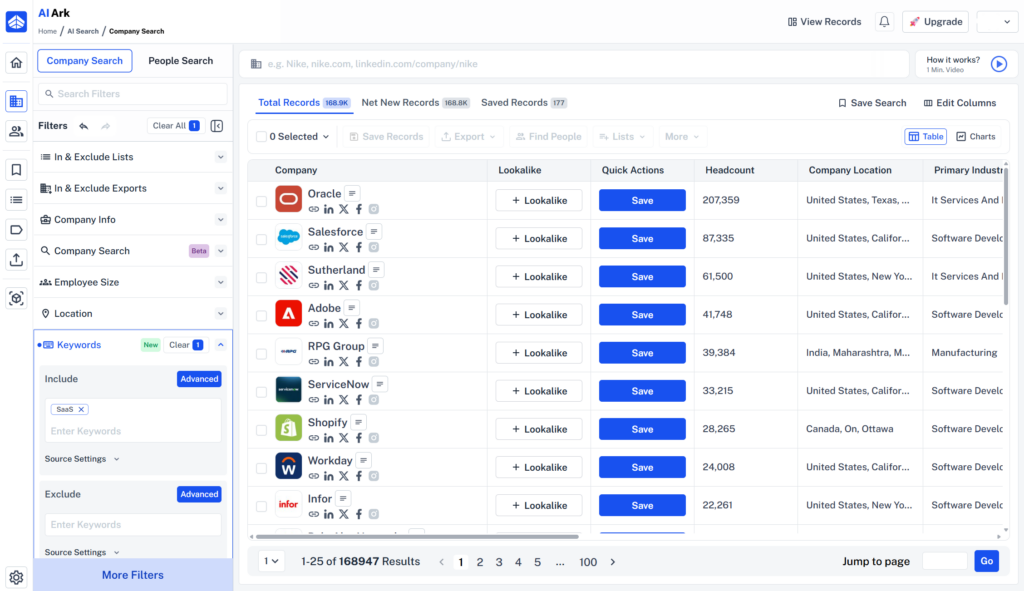
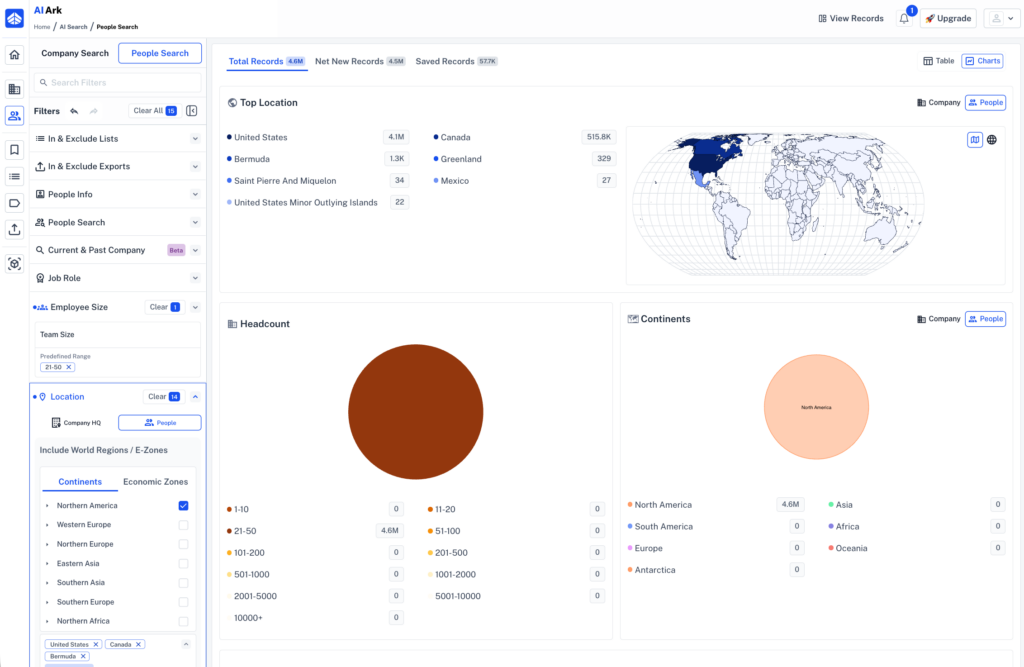
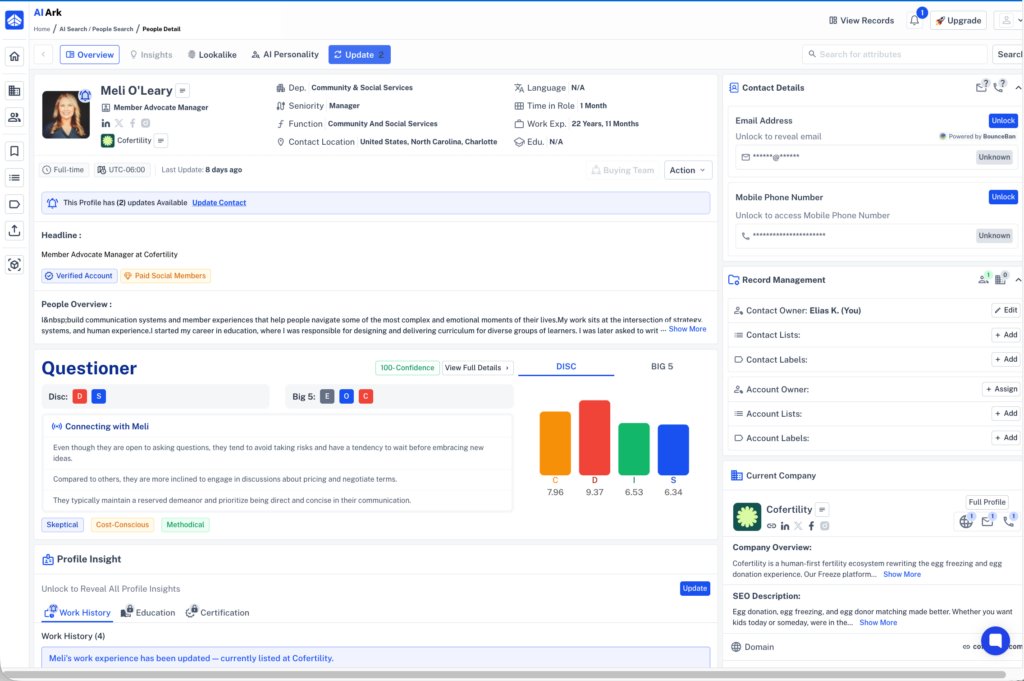
At its simplest, AI Ark is where you find the right people to reach out to and get a verified email for them. We have around 450 million people in the database, and each person carries about 256 fields — name, title, the languages they speak, company description, domain, email, mobile, and so on.
The people who get the most out of it are marketing agencies, which is exactly who we were, so the whole platform is built around how agencies actually work. Two features matter most. First, you’re not stuck searching by job title. Titles only tell you so much — try finding “marketing managers” by title alone and you’ll struggle. We let you search by what we call people keywords: things people mention on their profiles. So you can look for CEOs who mention SEO or “paid ads” in their bio, and you’ve basically found marketing managers responsible for these areas. Or GTM engineers who list Clay as a skill. No other database really lets you do that. Second, every email is verified in real time through our BounceBan integration, so what you export is usable immediately. You can reach all of it through the platform, an API, or an MCP server.
Every data provider claims accuracy. What do you do differently to keep a database
that size fresh, and how do you measure it?
Honestly, it comes down to the infrastructure, and that’s the part that took us years. We pull from thirteen different sources — data partners, data-sharing agreements, campaign data, email signatures, and more. Then we merge, clean, and de-duplicate. Say three sources all have a “John Miller.” Each one tells us when that profile was last looked up or last active. We built a system that reads all those signals and always takes the most recent update.
The rule we enforce is this: every single person in the database has been verified within the last 30 days. If we can’t find a recent update for someone — say the last one is three months old and none of our sources refresh it — we remove them. We’d rather have fewer, fresher records than a bigger stale list.
As for measuring it, we test against reality. A major sales-data platform has a toggle for people who changed jobs in the last 90 days. We took that list and checked it against the major providers. Every one of those job-changers was already updated in AI Ark. Other providers hovered around a 30% refresh rate, and we were shocked to discover that one major industry leader hadn’t updated a single person on that list. Their records were effectively six months stale. While I cannot speak to how they develop their product, our internal analysis was clear. It is exactly why I am confident that we provide the freshest data available today.
AI is reshaping how sales teams prospect. Where does AI genuinely change the game in the GTM space, and where is it still hype?
Where AI genuinely changed the game, I can point to two things from our own agency. We used to employ 40 to 50 people whose entire job was writing personalized opening lines by hand — we jokingly called them our “AI content writers.” Today Clay does that across 50,000 rows in a few minutes. Same with reply handling: we had 20 to 30 people classifying responses as positive, neutral, or negative and following up. Now three people do it, and they’re not even fully occupied, because AI classifies everything for us. We went from about 100 employees to around 30 largely because of this.
Where it’s still hype is full end-to-end automation of list building. I’ve talked to more than 300 agencies in the last few months, and almost all of them say they want to fully automate list building and just close their eyes while campaigns go live. I don’t believe in that, at least not yet. You still need a skilled GTM engineer to check the AI and give it good instructions. When I see people online claiming they automate absolutely everything with Claude Code, I’m skeptical they really do. The right model is smart people plus smart AI. AI is a fantastic assistant — even our finance manager uses Claude Code now — but it’s an assistant, not a replacement.
You sit on the supply side of outbound, so you see behind the curtain. What separates the teams that get real results from data and the teams that burn through it?
The teams that burn through data almost always have it backwards: they pour their energy into copy and treat the list as an afterthought. I think about it as a formula. A positive reply needs the right person — someone who has the problem and still works at the company — plus a valid email, and then a clear, relevant message. The list and the email are the foundation; the copy is only a multiplier on top of them. Right person, valid email, mediocre copy still has maybe a 50 percent shot, because the topic is relevant to them. But brilliant copy on an invalid email is multiplying by zero — the message never arrives. The winners understand that order. The teams that burn through data agonize over subject lines while emailing people who left a year ago.
That’s the second piece: freshness. Around 30 percent of people change jobs every year — that’s a Gartner number — and with AI it’s likely heading toward 45 or 50. On a 50,000-person list, that’s 15,000 people who’ve moved. If your provider refreshes every six months, you’re working the ghost of that list.
Now here’s the trap almost nobody accounts for: a valid email does not mean the person still works there. People tell me constantly, “I don’t need fresh data, I just run the list through an email verification tool and if the email’s valid they’re still there.” Wrong — because of what I call the alias trap. When someone leaves, their old address usually gets turned into an alias that forwards to whoever took over the role. So the verifier says “valid,” but you’re emailing someone who’s been gone a year, and their replacement is reading your “Hi (previous colleague’s name).”
Then there’s targeting by title alone, which quietly kills campaigns. A title is one piece of the buyer profile, not the whole thing. Pull “marketing managers” at software companies and you’ll get someone who lives in SEO and Google Ads sitting right next to someone running demand gen who lists Clay and GTM in their profile — same title, completely different buyer. If I’m selling a sending tool, only one of them is worth my email. The winners search the whole profile — the skills, the about section, the work history — to find who actually fits, instead of blasting everyone who happens to share a job title.
So it comes down to this: the teams that win respect that the list is the foundation, insist on fresh data, verify the person and not just the mailbox, target the real buyer, and treat deliverability as its own craft. The ones that burn through data skip all of it — and then blame the data when the copy can’t save them.
Bounce rates can make or break a cold email program. How does real-time verification change the economics for a sales team?
Bounce rates don’t just waste sends — they wreck your sender reputation and your whole program. Our BounceBan integration verifies every email in real time, whether you pull it through the platform, the API, or the MCP server. That means you can delete an entire step. We used to export data, run it through MillionVerifier, pull out the catch-alls, run those through another tool, and only then have a usable list. Now you export and go straight into your sequencer.
Around 68 to 70 percent of the emails people export from us are valid. When customers tell me they already pay Apollo a certain amount, I ask them to add it up honestly — Apollo plus MillionVerifier plus every other verification tool, divided by how many leads actually survive at the end. Every time, they’re paying more per usable lead with their old stack and ending up with fewer leads than they’d get from us.
I’ll give you the cost of getting this wrong. We once lost a client on day one of their campaign. One of the first people we messaged replied, “if you’d really checked my profile you’d have seen I changed jobs six months ago.” That single stale record was enough for the client to demand a refund and walk. Bad data doesn’t just lower your results — it loses you clients.
You’re not building from a traditional hub like the Valley. How does being remote-first actually function for your team?
Our first company AI bees was remote from literally day one, well before COVID made that normal. But your underlying question still holds: we built this outside any traditional startup hub, and that shaped everything.
Being remote from the start pushed us to hire from Southeast Asia, Eastern Europe, and Africa. Early on we had little revenue, and it was lower risk — for 1,000 dollars a month we could bring on hungry, talented people, train them, and pay them well above the average in their countries, so we were improving their lives at the same time. Put it this way: a nice office in my city runs about 5,000 a month, and for that same 5,000 I can hire five great people. I’ll take the five people every time.
But remote only works if you build real connection. We invested in culture from the beginning — virtual events, quarterly games, a “GTM engineer of the month” our team votes on, a newsletter, bonuses. That’s why so many of our people have been with us since day one, and some have literally built their own houses since joining. If you treat people as cheap labor, keep your camera off, and don’t care about them, remote will fail. AI Ark is fully remote too, and I’d build every future company the same way.
The data space is crowded. Where does AI Ark win, and what do you refuse to compete on?
We win on four things: freshness, with that 30-day guarantee; coverage, with 400+ million people versus Apollo’s 240 million; the people-keyword search that goes beyond job titles; and real-time email verification built in.
What we refuse to compete on is scraping. There are tools out there built by scraping Apollo or other platforms, and I’ll say plainly they won’t survive, because you can’t build anything durable on top of another platform’s data.
And in a strange way we refused to compete on speed-to-launch: we sat in beta for twelve months because we wouldn’t ship something that would crash or feel half-built. That perfectionism cost us time, honestly, but we weren’t willing to win by cutting those corners.
What is the most creative or unexpected way you have seen a customer use the platform?
Two come to mind. The one I always tell is the frozen fish company — a customer selling frozen fish who wanted to reach hotels and restaurants. On paper it sounds like a joke, but he was able to build great lead lists, and it was a genuinely successful campaign. It taught me not to prejudge what outbound can do.
The other is watching people get creative with the people-keyword search. Because you can search on what someone mentions in their profile rather than just their title, customers use it to isolate segments that are almost impossible to find otherwise — like identifying agencies by searching for founders who mention Clay or Claude in their skill-set or “bootstrapped” in their headline. That’s a completely different way of building a list than everyone else is doing, and people find angles with it we didn’t anticipate.
What is next for AI Ark, and what is the one lesson from building it you would hand a founder starting a data company today?
What’s next is mostly depth. There’s a long list of things we still want to improve in the platform, we’re rolling out regular newsletters with real GTM advice, and we’re working on pushing that email validation rate above 70 percent by testing different domains. Bigger picture, this is our move from a service business with a low ceiling to software with a much higher one, and we keep building features based on what customers ask for.
The one lesson I’d hand a founder starting a data company today: ship before it’s perfect. We chased perfection for years and only went live because people started posting about us publicly without even telling us — I woke up to it. If that hadn’t forced our hand, I’m certain we’d still be finding reasons to wait. The market feedback is what actually makes the product good. Build on something sustainable, let a services business fund the software if you can — but don’t let “not ready yet” become the thing that stops you.
www.ai-ark.com