



Business Enquirer speaks with Eva Robson, Business Development Director at J Coffey, about the relationships behind the company’s work across the UK and Europe and what sustainable growth looks like at scale.
“Our growth has never been driven by chasing volume,” says Eva Robson, Business Development Director at J Coffey. “It’s been driven by building trust and then delivering on that trust.” That principle runs through every stage of the company’s expansion — from its roots as a UK civil engineering contractor to its current position at the centre of Europe’s data centre and energy boom.

Eva Robson, Business Development Director at J Coffey
A Foundation Built on Repeat Business
As Business Development Director, Robson’s role is to build and maintain strategic client relationships while shaping the long-term growth of J Coffey’s Data Centres & Energy division — working closely with clients, consultants and supply chain partners to anticipate where markets are heading.
Founded by James Coffey in 1991, J Coffey Group has grown into a £185 million turnover business operating across five specialist divisions: J Coffey Construction, J Coffey Infrastructure, J Coffey Data Centres & Energy, J Coffey Fire & Builderswork, and BethMar, all supported by J Coffey Plant, delivering projects throughout the UK and Europe.
That growth, Robson says, has been built on repeat business, technical excellence and trusted relationships — recognised recently through a Best Specialist Contractor win at the Construction News Life Sciences Awards and a high commendation in the Concrete Society Awards for the UCL Student Centre project. “My role is less about selling projects,” she says, “and more about creating long-term partnerships that allow us to grow sustainably alongside our clients.”
Following Clients Into Ireland and Europe
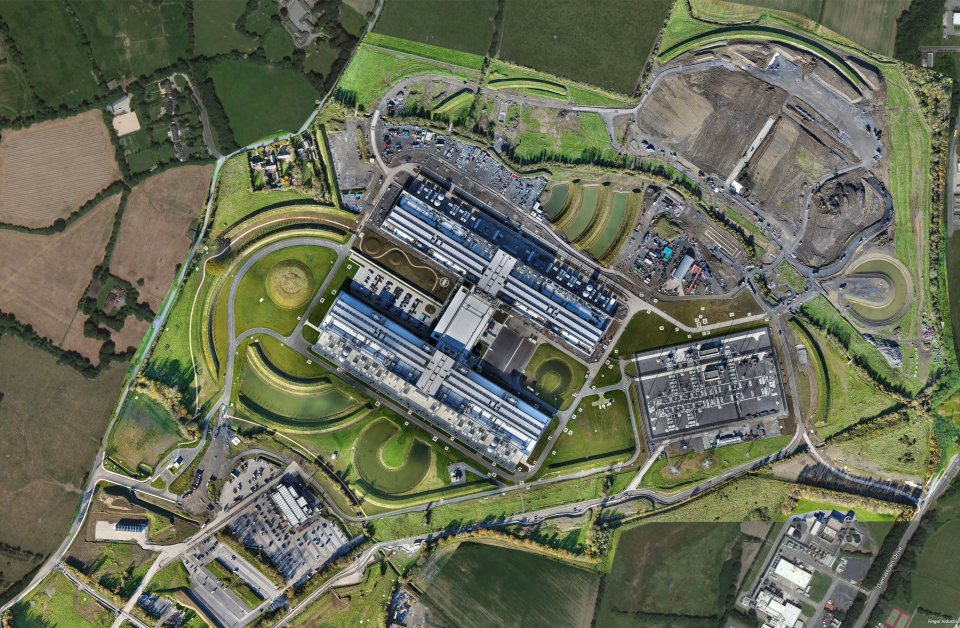
J Coffey’s move into Ireland in 2015 was, in Robson’s words, entirely client-led. “We didn’t expand into Europe for the sake of expansion, we followed trusted clients and delivered where they needed us.” Mace were expanding their presence in Ireland through the development of Meta’s Data Centre Campus and brought J Coffey in as part of a trusted supply chain — a project Robson describes as a defining moment for the business.
Delivered across multiple phases, the Meta project saw J Coffey take on extensive civil engineering, utility and structural concrete packages: hundreds of kilometres of ducting, major earthworks, utility infrastructure, hard landscaping, and large structural concrete programmes. Across six phases over three years, the work was worth more than €200 million and gave the company extensive experience constructing hyperscale facilities.
From there, J Coffey expanded into Denmark, delivering a hyperscale data centre near Copenhagen for Exyte. Today J Coffey’s footprint extends further into mainland Europe, with live projects in the Netherlands and Germany alongside continued growth across the UK.
In House Expertise
Robson is clear that J Coffey’s move into hyperscale facilities did not require reinventing the business. “The data centre market didn’t change who we were,” she says. “It amplified capabilities we’d already spent decades developing.” Before taking on hyperscale work, the company had already built significant expertise in complex civil engineering, utilities and structural alterations, along with smaller data centre packages — giving them strong technical foundations in programme certainty, quality assurance, Contractor’s Design Portion (CDP), and sequencing methodologies.
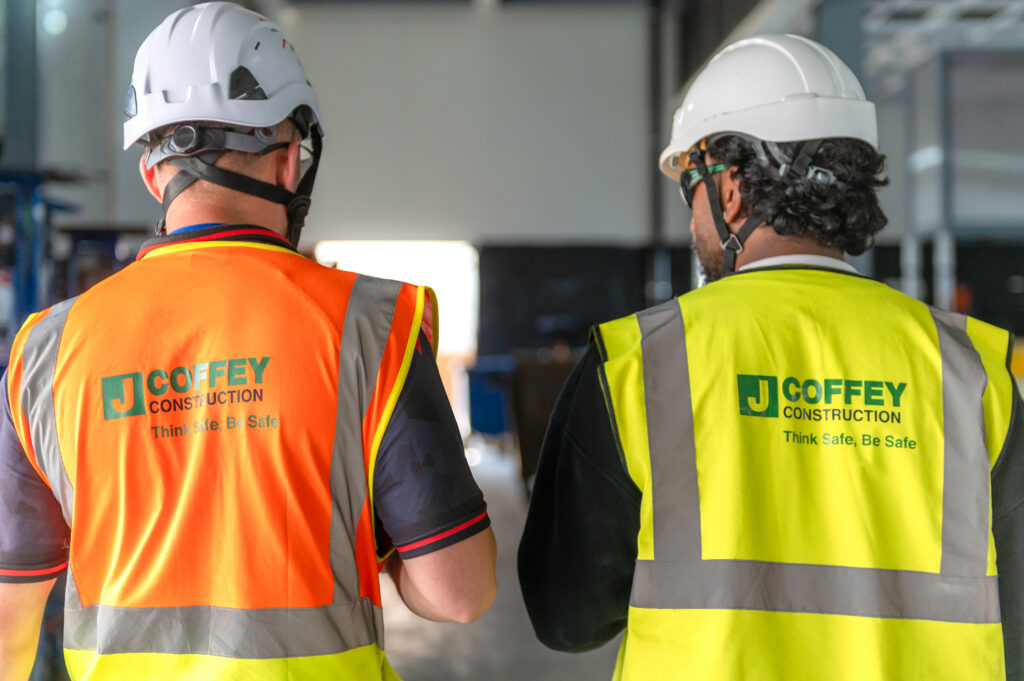
What distinguishes J Coffey within the sector today, Robson says, is a self- delivery model underpinned by an engineering-led culture. “We’re engineers,” she says simply. The company provides project management, pre-construction services, civil engineering, structural works, its own plant and workforce, temporary works design and BIM coordination under one roof, with site teams led by engineers who understand both design intent and buildability, enabling faster decisions and greater programme certainty. That extends to close collaboration with MEP contractors, reflecting the reality that power, cooling and operational resilience now drive modern data centre construction.
Reducing Interfaces, Increasing Certainty
“Integration creates certainty, and certainty is incredibly valuable on a data centre project,” Robson explains. With more interfaces on a project comes greater potential for delays and coordination issues, a risk J Coffey addresses through in-house BIM capability that supports design coordination and clash detection early in the process. The company regularly supports clients through Early Contractor Involvement (ECI) and Pre-Construction Services Agreements (PCSA), refining designs for buildability before construction begins. On the recently completed Park Royal data centre, Robson says this integrated BIM approach significantly reduced risk and improved programme certainty.
“The data centre market didn’t change who we were,” she says. “It amplified capabilities we’d already spent decades developing.”
The Shift Towards Power-Enabled Infrastructure
“Power availability is now one of the defining challenges facing data centre growth,” Robson says, “and it’s reshaping what clients expect from their construction partners. The conversation, she explains, is no longer just about building data centres. It is about delivering the power-enabled infrastructure needed to support them. Substations, energy centres, battery storage and associated civil works are now critical parts of many projects. Clients want to understand not only how power will reach a site, but also how resilience and future expansion will be achieved.
Clients are also seeking larger, more integrated packages with fewer interfaces and greater accountability, a shift that plays to J Coffey’s combined data centre and energy capability. On their Park Royal project, for example, the company delivered both the data centre construction and the substation build, including basements, substructure works, steel frames, precast stair cores, and building envelope works. The growing complexity of power-integrated data centres is driving greater emphasis on early contractor involvement. “The best problems are the ones you solve before construction begins,” Robson says, describing how early engagement lets the company challenge assumptions, improve buildability and identify risks before they affect cost or programme. This gives clients greater certainty and contractors a clearer understanding of project objectives.
Where the Opportunities Lie
Robson sees the strongest Data
Centre & Energy opportunities across three areas. First, she points to the UK Government’s AI Growth Zones, identified as strategic locations for AI and data centre investment as the UK looks to prioritise grid access, accelerate utility investment and streamline planning approvals for large-scale digital infrastructure. Within this emerging landscape, Robson specifically highlights the North East and Scotland as areas of opportunity. Second, London, which continues to account for more than 80% of UK data centre capacity. And third, the Nordic region, where renewable energy availability and supportive infrastructure are attracting major investment — a market J Coffey has already proven it can operate in through its Denmark delivery. Alongside data centres themselves, Robson points to substantial growth in substations and battery energy storage systems, sectors in which J Coffey has a proven delivery track record.
Making Sustainability Measurable
“Sustainability has to work operationally, not just look good in a report,” Robson says, noting that clients increasingly want measurable outcomes rather than high-level commitments. J Coffey has focused on practical innovations that cut carbon, waste and fuel use without compromising productivity or programme, including a significant increase in the use of lower-carbon, GGBS-based concrete mixes, which delivered a saving of more than 709 tonnes of CO2e between January and July 2025 alone.
Through a partnership with Tarmac, the company has deployed CEVO digital concrete technology on projects including The Oxford Science Park. Small wireless sensors are placed on the reinforcement steel before the concrete is poured, continuously monitoring temperature and curing behaviour once embedded. That data feeds AI-driven maturity models that predict strength development in real time, replacing the traditional wait for cube-testing results. The result, Robson says, is far greater confidence in decision-making, with formwork and temporary supports including being able to strip formwork and remove temporary props sooner, in some cases up to 40% faster than traditional methods. It also gives the company confidence to use higher-GGBS, lower-carbon mixes while maintaining assurance around performance and programme.
The company is also cutting emissions on site: last year, 56% of its fuel consumption was HVO, and 80% of its plant fleet was electric or hybrid. J Coffey has delivered 157 hours of sustainability training to its teams, and on one London data centre project incorporated a living wall to support biodiversity and local planning objectives. For data centre clients specifically, Robson notes that sustainability is increasingly tied to energy resilience, an area where J Coffey’s combined Data Centres & Energy capability, spanning substations, energy centres and battery storage, positions it well.
Consistency Across Borders
Entering new European markets brings challenges around local labour regulations, supply chains and compliance requirements — the biggest hurdle, in Robson’s view. J Coffey has built this capability organically through repeat work and experienced teams, including Irish colleagues who have worked with the company for more than a decade and can operate across multiple EU jurisdictions with fewer barriers to entry. ”The advantage of following existing clients,” Robson says, “is established relationships, proven systems and trusted delivery practices.”
Relationships as the Business Model
For Robson, long-term client relationships aren’t just a nice-to-have, they’re the foundation of the business. “Projects start with contracts,” she says, “but careers and businesses are built on relationships.” Partnerships with clients, built over many years, have enabled J Coffey to deliver some of their largest and most complex projects. As a family business, the company takes a long-term view, prioritising trusted partnerships over any single project — and Robson notes that many of their opportunities in Ireland and Europe originated simply because clients already knew and trusted how J Coffey works.
Looking Ahead
Robson describes the next phase of growth, for the Data Centre and Energy Division, as sitting “at the intersection of digital infrastructure, power and trusted partnerships”. The ambition, she says, is “sustainable, controlled growth that maintains the culture and quality clients associate with the business, with continued investment in innovation, sustainability and modern methods of construction. Power infrastructure, substations and battery storage are expected to become increasingly central to the company’s work while they maintain their delivery of data centres, as AI continues to drive demand”.
“Most importantly,” Robson says, “we’ll continue growing through trusted relationships.”
www.jcoffey.com