


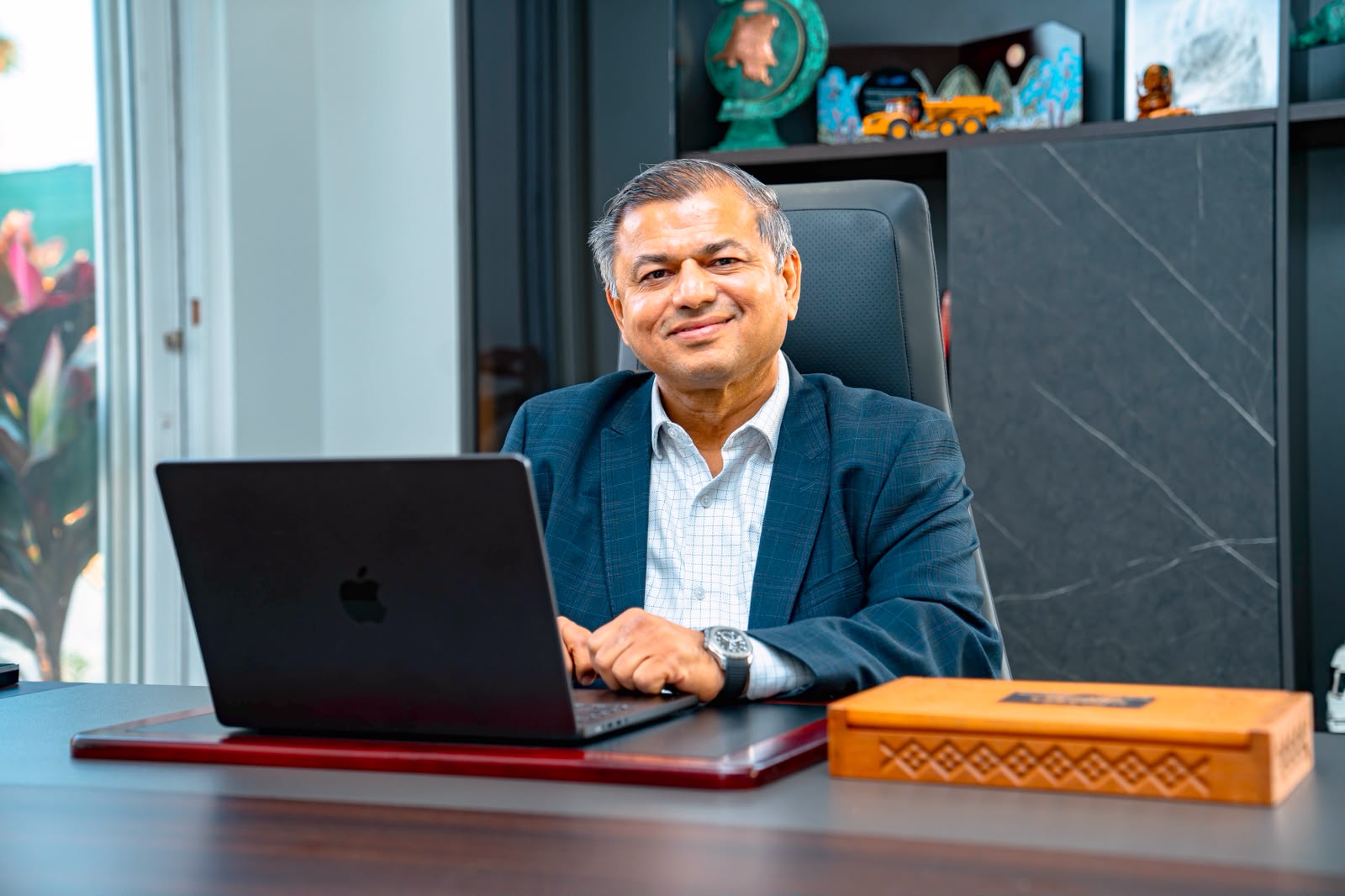
How Chetan Chug built a business rooted in resilience, value creation and long-term commitment to Africa
In 1997, a young entrepreneur arrived in Tanzania carrying a copy of Sam Walton’s autobiography, a belief in the potential of African trade, and an idea. Nearly three decades later, that idea has grown into one of the most diversified business groups operating across Central and East Africa.
Today, Vinmart Group spans mining, logistics, manufacturing, renewable energy, real estate, infrastructure and more. From a commodity trading hub in Dar es Salaam to a multinational organisation with offices across China, India, South Africa, Zambia, Mauritius, Turkey, Canada, the UAE and beyond, the company has become a powerful example of strategic adaptation, vertical integration and long-term investment in the African continent.
For Chetan Chug, Chairman of Vinmart Group, the journey is one he describes with characteristic modesty. Yet the scale of what has been built is anything but modest.

At its core, Vinmart’s story is about more than business expansion. It is about seeing opportunity where others see complexity, building industrial capacity where markets need resilience, and turning operational challenges into platforms for growth.
“Vinmart’s journey is a story of adaptation, resilience and value creation across some of Africa’s most strategically important sectors.”
From Rajkot to Dar es Salaam
Chetan Chug’s entry into African business was shaped by two very different sources of inspiration.
The first was deeply personal. His father, Vinodrai Chug, was a chaiwala who owned a tea shop in Rajkot, India. It was there that Chetan was introduced to the fundamentals of business from a young age, serving customers, managing inventory, handling billing and balancing the books.
Vinodrai passed away in 1996, leaving Chetan with a wish to see the Chug family grow. That sense of family ambition would become one of the foundations of the business that followed.
The second source of inspiration came from Sam Walton, founder of Walmart. Walton’s approach to scale, simplicity and distribution encouraged Chetan to think differently about trade. The name Vinmart itself reflects those two influences, combining “Vin” from Vinodrai and “Mart” from Walmart.
Establishing Dar es Salaam as a central hub, the early Vinmart model focused on importing bulk soft commodities, including rice, sugar and wheat flour, before redistributing them in smaller parcels to markets across Zambia, the Democratic Republic of Congo, Rwanda, Burundi, Uganda and Malawi.
It was a logical and scalable model, but it also exposed the business to a challenge familiar to many import-dependent companies operating across Africa: foreign exchange.

The Mining Pivot
By 2001, Chug recognised that Vinmart needed to become a net earner of foreign currency rather than a consumer of it. The answer lay underground.
The group pivoted into mining through the establishment of Somika, initially focused on trading cobalt concentrate before evolving into the processing and production of cobalt hydroxide and copper cathodes. It was a bold move into a capital-intensive and technically complex sector, but one that fundamentally changed Vinmart’s financial profile.
This period also marked the beginning of a long-standing partnership with Umed Dhrolia, who placed his trust in Chug through an initial capital injection into Somika and continued guidance as the organisation grew. Together, they helped shape Somika’s defining ethos: “Somika, c’est ma famille, Congo c’est mon pays”, meaning “Somika is my family, Congo is my country.”
“Somika is my family, Congo is my country.”
Another important figure in this phase was Paresh Kakkad, Chetan Chug’s brother-in-law, who supported the establishment of Kisanfu Mining, the group’s first mine-to-metal operation. During the cobalt boom, his focus on operational discipline helped ensure strong production levels, strengthening the platform that supported Vinmart’s future growth.
As mining operations expanded, Vinmart identified another gap in the market. Specialist drilling support was scarce and expensive, so Chug established Solutions for Africa, a subsidiary initially designed to serve the group’s own projects, including Kisanfu, Lupoto and Kimpe. It quickly evolved into an independent service provider for the wider mining industry.
Diversification as a Discipline
The 2007–2008 commodity price crash became a major stress test for mining operators across the continent. Vinmart responded by broadening its minerals portfolio through Mining Mineral Resources, known as MMR, adding tin, tantalum, tungsten and gold, the so-called 3T-G minerals, to its operations.
Spearheaded by Chetan’s cousin, Hitesh Chag, the move helped improve cash flow balance and reduce exposure to single-commodity volatility. Today, MMR operates in full compliance with OECD guidelines and has established itself as a regional leader in 3T products, with the biggest tin smelter in Africa and one of the few companies globally capable of metal-to-alloy production.
Around the same time, Chug identified another opportunity within the group’s own supply chain. The demand for steel, and the cost of importing it, led to the founding of Sotrafer in 2005. The scrap metal recycling operation produces reinforcing bars for the local construction market and has become the only sizeable steel manufacturer in southern DRC.
With seasoned steelmaker Kalpesh Patel joining hands with the group, Sotrafer became an early expression of what would become a defining Vinmart philosophy: convert local resources into finished products, retain value on the continent and reduce dependency on imports.
“Convert local resources into finished products, retain value on the continent and reduce dependency on imports.”
A similar logic drove the creation of Mining Engineering Services, known as MES. Through frequent visits to mines and a close understanding of the operational challenges they faced, Hitesh Chag identified the opportunity to build local recycling initiatives for mining equipment.
These initiatives included used oil recycling, cathode refurbishment and anode production through lead battery recycling, areas that had previously relied on South Africa for treatment and supply. MES has since expanded into engineering, procurement and commissioning services for third-party mining operators.
It is a story built on practical problem-solving, but also on a wider mission to improve the mining ecosystem in the DRC and ensure operators have access to the support they need locally.

Copper to Cable
Perhaps the clearest expression of Vinmart’s downstream ambitions is Congo Cable Transformer, known as CCT, launched three years ago.
The group’s mining operations produce copper cathodes of 99.9 per cent purity. Rather than simply exporting that raw material, CCT manufactures cables locally, creating employment, retaining value within the DRC and completing a production loop that runs from the earth to the finished product.
It is precisely the kind of value addition that economists, policymakers and development organisations have long argued African economies must pursue. Vinmart is not simply discussing that future; it is building it.
By turning raw materials into finished products within the region, the group is helping demonstrate how African industrial development can move beyond extraction and towards manufacturing, skills development and long-term economic resilience.
Logistics, Assembly and Regional Scale
Mining and manufacturing are only as strong as the logistics systems that support them. Vinmart addressed this through AMPM, a transport company established in Tanzania that has grown from a fleet of five trucks to more than 400.
Today, AMPM operates as a critical clearing and forwarding hub between Dar es Salaam and the DRC, supporting the movement of goods across one of the region’s most important trade corridors.
The group has also moved into vehicle assembly with Tanzanian local partners Chirag Tanna and Mouna Habib. Through a collaboration with Chinese automotive manufacturer Sinotruk, Vinmart has helped develop Saturn, an assembly plant in Tanzania with a current capacity of 3,000 units per shift and plans to double output through a two-shift production model.
The venture reflects a broader confidence in the growth of Chinese automotive brands across Africa. More importantly, it positions Vinmart as an active participant in that growth, rather than simply a customer of it. The same local partners are also helping to drive Vinmart’s move into mining in Tanzania.
Paresh also supported the group’s dealership relationships with Tata and Mahindra, working alongside partner Meenu Purohit to create Panafrique Motors. The company is now expanding its reach in and around the DRC, further strengthening Vinmart’s presence across mobility, logistics and industrial support.
Building the Infrastructure Africa Needs
Real estate and infrastructure development became another area of opportunity for Vinmart in 2012, when Rahim Dhrolia, the first member of the second generation to enter the family business, identified potential across commercial and residential projects in the region.
With Rahim’s dynamism and drive, the portfolio has expanded to include landmark public infrastructure projects, including the governor’s office in Lualaba Province and the airport in Kolwezi. These projects speak to the group’s deepening integration into the economic and civic fabric of the markets in which it operates.
Energy has become another major focus. Since 2021, Chug had observed mines relying increasingly on diesel to run operations due to unreliable grid power. After reflecting on the challenge, he contacted his cousin, Rushi Chag, who was based in China, and placed an order for 5MWp of solar panels as a pilot project.
The success of that pilot led to the creation of Solutions 4 Energy, spearheaded by Chetan’s daughter, Sneha Chug. S4E has now installed close to 100 megawatts of photovoltaic solar panels and more than 150 megawatts of battery storage across mining and commercial sites.
These systems provide clean and reliable energy to industrial clients and surrounding communities, making a meaningful contribution to Africa’s energy transition through private enterprise responding to real market need.
“Vinmart’s clean energy work is not theoretical. It is practical, industrial and directly connected to the needs of African businesses and communities.”
A Global Network Built for Independence

Vinmart’s international offices in China, India, South Africa, Turkey, Zambia, Canada and the UAE were originally established to secure supply chain control and optimise procurement. Over time, however, they have evolved into something more significant: independent profit centres.
Today, more than 40 per cent of their business comes from clients outside Vinmart Group itself, turning what began as internal infrastructure into a revenue-generating global network.
Vinmart’s first international office was established in China under the leadership of Rushi Chag. In 2000, Chetan and his brother Umesh sent him to the Canton Fair to source products for the group’s trading division. What began as an order for two containers became a permanent presence in China.
Twenty-six years later, Rushi remains there, having helped build a strategic hub that supported Vinmart’s first cobalt trading book and its access to heavy-duty machinery for processing and manufacturing operations in the DRC.
Equally important is the contribution of Chetan’s brother-in-law, Bhavesh Buddhadev, who leads Excelsource International in India. Under his leadership, the business has developed not only as a sourcing hub for the group, but also as a technology solutions provider for the African continent. Its new urban mobility venture, Nutran, is designed to change the way people move within cities.
It is a model that reflects Chug’s consistent instinct to identify commercial value within the operational necessities of running a large, complex business.
People, Purpose and the Vinmart Foundation
Underlying Vinmart’s commercial activity is a philosophy of empowerment. Chug speaks of trusting teams, delegating execution and building management capable of carrying the organisation forward. That leadership style has allowed the group to scale across multiple sectors and geographies without losing coherence.
The Vinmart Foundation formalises this commitment through four pillars: education, healthcare, entrepreneurship and infrastructure. Sneha Chug has played an important role in structuring the Foundation, helping to shape its programmes and social impact.
Among its initiatives, the Foundation sponsors and organises free consultation and surgical camps, treating more than 1,000 patients annually. It also supports the construction of major schools, hospitals and bore wells, while preparing and funding the children of blue-collar Vinmart Group team members to pursue higher education abroad each year.
This is more than philanthropy. It is an investment in the next generation of African business, technical and civic leadership.
Family remains central to Chug’s story. He attributes much of his resilience and success to his wife, Arti, whose support has helped shape his long-term outlook and commitment to legacy. Generational continuity within the Chug family is also central to Vinmart’s future, with second and third-generation family members bringing new technologies, fresh thinking and renewed energy to the group while preserving the values that have guided it from the beginning.
“The Vinmart Foundation reflects a belief that business growth and community development should move together.”
The Road to 2050

Chetan Chug is not thinking in quarters. Vinmart is currently developing a strategic vision that spans the next 25 years, taking the group towards 2050. That horizon reflects both the scale of opportunity he sees in Africa and the depth of commitment Vinmart has made to the continent.
The priority is downstream value addition: processing raw materials within Africa before they are exported, retaining economic benefit on the continent and creating skilled employment in the process. It is an ambition that places Vinmart firmly within the wider debate about Africa’s industrial future.
For Business Enquirer, Vinmart represents more than a diversified business success story. It is a case study in how trade can become industry, how necessity can become innovation, and how a business built from humble beginnings can evolve into a platform for continental development.
The legacy Chug envisages is one of resilience and transformation: a small trading start-up that became a diversified African industrial enterprise, using its scale not simply to generate returns, but to build infrastructure, skills and communities that help economies thrive.
From Vinodrai’s chai shop in Rajkot and a Sam Walton autobiography to a diversified African industrial group, Vinmart’s story is still being written. And if Chetan Chug has anything to say about it, the most important chapters are yet to come.