


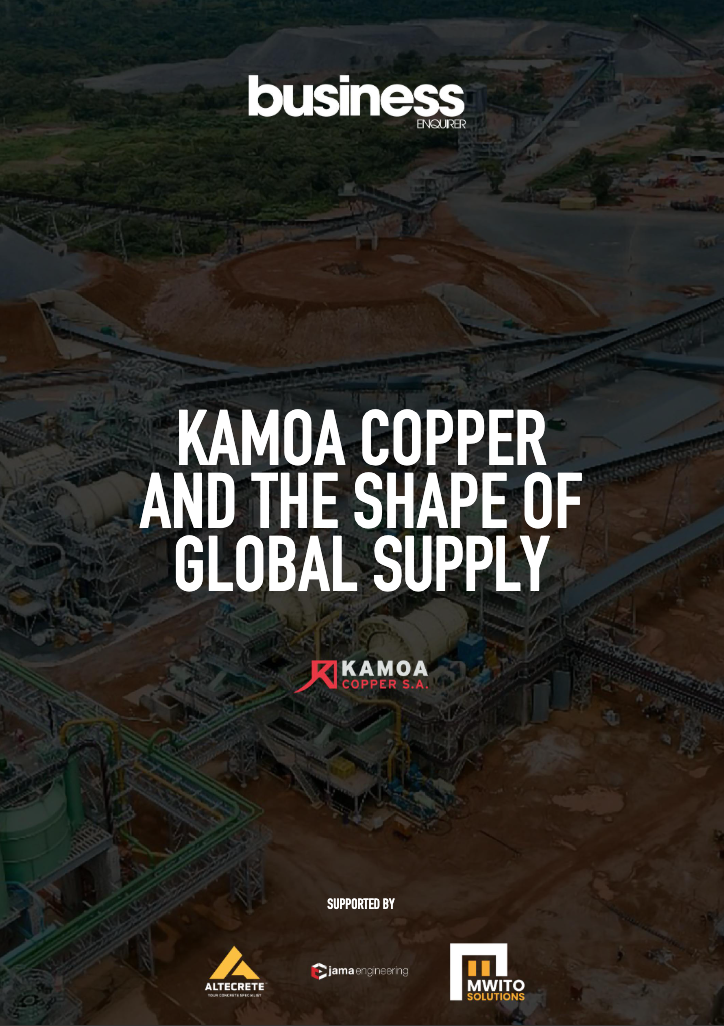
There is a shift underway in the global copper market. It is not being driven by speculation or discovery, but by execution at scale and the ability to deliver certainty in an increasingly constrained supply environment.
In the Democratic Republic of Congo, Kamoa Copper has moved beyond its identity as a high-grade asset and into a far more strategic role. The Kamoa Kakula Mining Complex now stands as one of the most important integrated copper operations in the world, positioned at the centre of a market defined by electrification, infrastructure expansion and long-term demand.
Copper is no longer a cyclical commodity. It is a structural requirement. Power networks, electric vehicles, renewable energy systems and data infrastructure all depend on reliable copper supply. The question facing governments and industry is not whether demand will increase, but whether supply systems are robust enough to meet it.
Against this backdrop, Kamoa Copper is emerging as a defining asset. What distinguishes the operation is not only the quality of its orebody, but the way in which it has been developed. This is no longer a mine supported by infrastructure. It is an integrated industrial system designed to produce, process and refine copper within a single operational framework.
The commissioning of Africa’s largest and one of its most environmentally advanced direct-to-blister copper smelters marks a decisive moment in that evolution. By producing blister copper on site, Kamoa Copper has removed a critical dependency from its value chain. The traditional model of exporting concentrate for third-party processing has long exposed producers to logistical constraints, geopolitical risk and margin dilution. Kamoa Kakula has addressed this directly.
The smelter anchors the operation as a self-contained production system. It strengthens supply chain control, reduces transport intensity and retains significantly more value within the Democratic Republic of Congo. It also signals a broader shift in how large-scale mining projects are being conceived across Africa. Integration is no longer an ambition. It is becoming the standard for long-term competitiveness.
This progression has been matched by a disciplined approach to growth. Production expansion at Kamoa Kakula is being delivered with a level of precision that reflects both geological strength and operational maturity. High grades continue to underpin strong margins, while infrastructure investment in power, logistics and processing capacity provides resilience against external disruption.
Few assets globally combine this level of grade, scale and infrastructure readiness. Fewer still are able to expand without compromising performance. In a market where supply risk is increasingly shaped by factors outside the mine itself, that distinction is significant.
Leadership has played a central role in shaping this trajectory. The appointment of Annebel Oosthuizen as Managing Director comes at a defining point in the operation’s development. Recognised among Mining Elites 2026 as an Outstanding Leader, her tenure reflects a broader evolution in how mining organisations are led.
The emphasis is clear. Operational accountability, workforce engagement and long-term capability building are treated as core components of performance. In an environment as complex as the DRC, execution depends as much on organisational strength as it does on engineering.
Kamoa Copper’s continued investment in Congolese talent reflects this understanding. Training programmes, leadership pathways and skills development initiatives are not positioned as peripheral. They are fundamental to sustaining an operation of this scale. A project designed to operate over decades requires a workforce capable of growing with it.
Environmental performance is another defining dimension. The smelter has been developed with modern emissions controls and efficiency measures that align with international expectations. This is not simply a regulatory consideration. It is a strategic one.
Copper sits at the centre of the global energy transition, yet its production has often carried a significant environmental footprint. Operations that can demonstrate credible, lower-impact processing will increasingly differentiate themselves in the eyes of investors, partners and end users. Kamoa Copper is positioning itself accordingly.
The broader market context reinforces the importance of this approach. Global copper supply is tightening. New discoveries are limited, permitting timelines are extending and capital requirements are rising. At the same time, demand continues to accelerate, driven by electrification and digital infrastructure.
This imbalance places greater weight on existing tier one assets. Operations capable of delivering consistent, long-term supply will define the next phase of the market. Kamoa Kakula sits firmly within this category.
Its combination of grade, scale and integrated infrastructure positions it as a stabilising force in an increasingly volatile landscape. For manufacturers, utilities and governments, access to reliable copper supply is becoming a strategic priority. Assets that can provide that certainty will carry disproportionate influence.
The significance of Kamoa Copper extends beyond production. It reflects a different model for resource development. Integration over fragmentation. Long-term infrastructure over short-term optimisation. Local value creation alongside global supply.
The impact of this model is already visible. Domestic processing capacity supports employment, skills development and industrial capability within the Democratic Republic of Congo. While mining alone does not define economic transformation, projects of this scale can act as anchors for broader development when aligned with national priorities.
What comes next is defined by execution. Scaling output further, optimising smelting performance and maintaining safety and environmental standards will test both systems and leadership. These are complex challenges, but they are consistent with the ambition that has defined the project to date.
Kamoa Kakula has progressed from discovery to development, from development to production and now to full industrial integration with a level of consistency that is rare at this scale. The underlying systems suggest an operation built not only for growth, but for endurance.
The copper market is entering a decade defined by constraint, competition and strategic importance. In that environment, the value of certainty increases.
Kamoa Copper is not simply producing copper. It is shaping how copper supply will be delivered.