


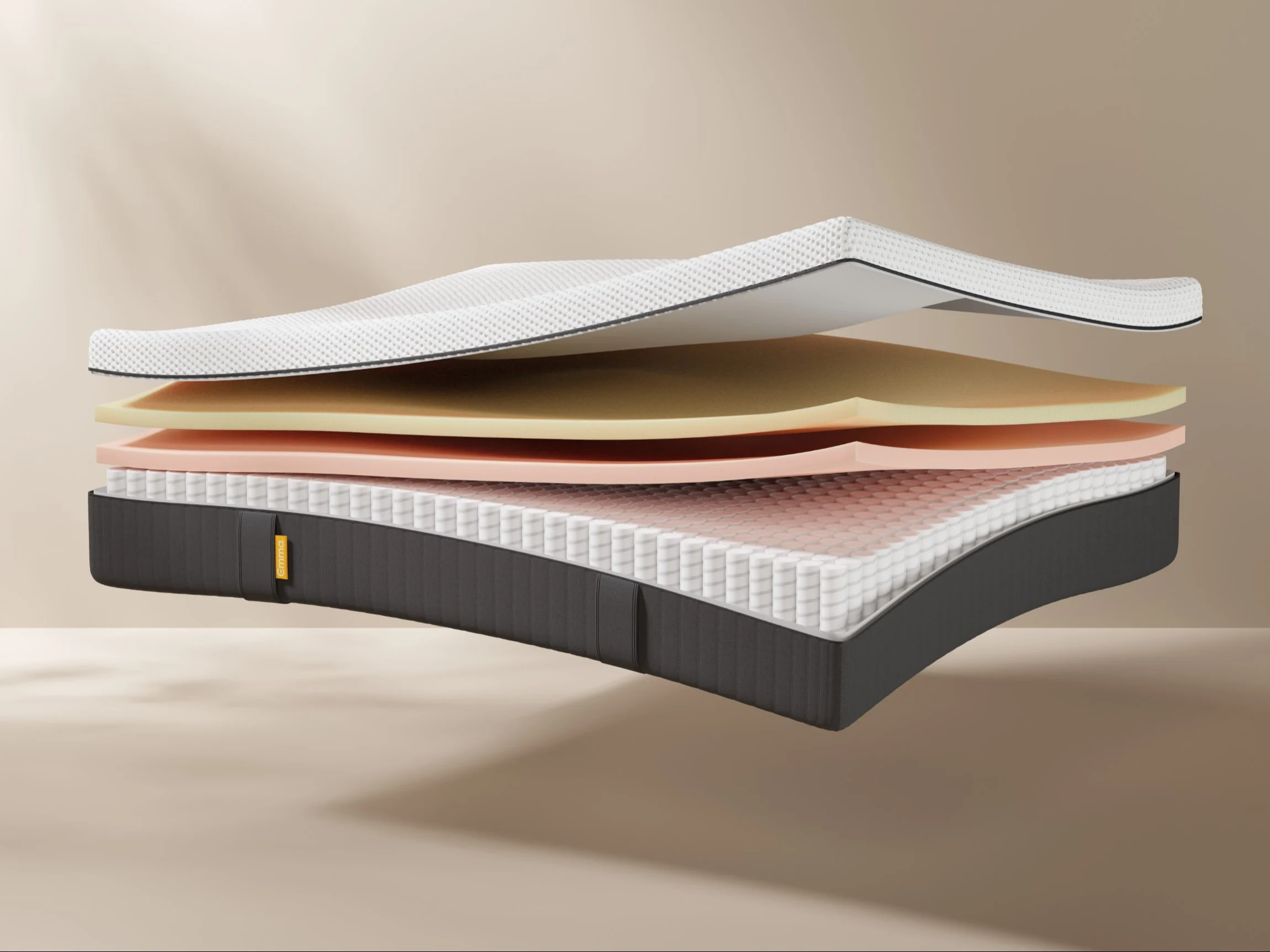
There is a quiet paradox at the heart of modern commerce. The faster companies move, the more fragile they often become. Speed, once a competitive advantage, can turn brittle under scale. Systems stretch. Processes fracture. Promises slip. And yet, in certain organisations, growth does not dilute precision. It sharpens it.
Emma Sleep sits firmly in that rarer category.
What began as a digital-first disruptor, built on the elegantly simple premise of delivering mattresses in a box, has matured into something far more complex. Operating across more than 30 markets, the company now finds itself navigating a transition that has undone many of its peers. Moving from a purely digital model into physical retail is not simply a channel expansion. It is a fundamental rewiring of how a business thinks, builds, and delivers.
At the centre of that evolution is Stefan Hofer, a leader shaped by decades of retail and supply chain transformation. His arrival marks a deliberate shift in how Emma understands its next phase. Not as a continuation of momentum, but as a recalibration of what growth should mean.
“I have this kind of saying for me that process is not the enemy of speed, it is a badly designed process that is the enemy of speed.”
It is a deceptively simple idea, but one that cuts to the core of Emma’s strategy. In the world of high-growth scale-ups, the process is often treated with suspicion. It is seen as the first step towards bureaucracy, the beginning of a slow drift away from entrepreneurial instinct. Hofer rejects that binary entirely. For him, process is not something to be resisted, but something to be designed with intent.
That distinction matters. Because Emma is no longer a start-up. It is a maturing global operator, one that must reconcile the agility that fuelled its rise with the structure required to sustain it.

The move into physical showrooms reflects that shift in thinking. On the surface, it is a logical extension of brand presence. A chance for customers to touch, feel, and experience a product that has, until now, lived primarily in digital space. But beneath that, it is a far more nuanced strategic decision.
For a company built on direct-to-consumer efficiency, introducing physical retail creates immediate tension. Inventory models change. Supply chains become more complex. Customer journeys fragment across channels. The simplicity that once defined the business begins to erode.
Hofer is candid about the reality of that transition.
“When you start digital first and you are a D2C player, we have mattresses in a box. That was the concept of how Emma got successful. When you enter the retail space it is a completely different setup for the supply chain, specifically on the final mile and the warehousing part.”
It is here, in the operational detail, that Emma’s next chapter is being written. Not in marketing narratives or expansion headlines, but in the less visible work of redesigning systems that can support both digital and physical worlds without compromising either.
The challenge is not simply to build a retail presence. It is to do so without cannibalising the efficiency that made the company successful in the first place.
That requires a different kind of discipline. One that is less about adding capability and more about protecting coherence.
“We need to rethink how we distinguish the offline portfolio from the online portfolio and how we secure having a proper supply chain in all the flows without cannibalising the successful way of how Emma has been doing D2C.”
There is a quiet restraint in that thinking. A recognition that growth is not always about expansion, but about balance. About knowing which elements of the business must evolve, and which must remain untouched.
Nowhere is that more evident than in Hofer’s reframing of the supply chain itself.
In many organisations, supply chain remains a functional discipline. A cost centre. A necessary infrastructure that sits behind the scenes, enabling the business but rarely shaping it. At Emma, that perspective is being fundamentally redefined.
“To me supply chain is more a consumer promise, a customer promise, a brand promise than it is a logistics function.”
It is a statement that shifts the entire conversation. If supply chain is a promise, then it is no longer peripheral. It becomes central to how the brand is experienced. Delivery times, product availability, consistency across markets. These are not operational metrics. They are expressions of trust.
That shift in mindset has practical consequences. It changes how decisions are made. It reframes priorities. It demands a level of cross-functional collaboration that many organisations struggle to achieve.
Hofer speaks of the need to challenge complexity at its source.
“Where are we paying for complexity today, and where do we pay for complexity that the customer never sees?”
It is an uncomfortable question, precisely because it forces organisations to confront inefficiencies that have often been rationalised or overlooked. Complexity, in many cases, accumulates gradually. A workaround here, an additional process there. Over time, it becomes embedded.
At Emma, the effort is to reverse that drift. To strip back what does not add value, and to rebuild systems that are aligned with the customer experience rather than internal convenience.
This is not a one-time exercise. It is an ongoing discipline. One that requires constant interrogation of how the business operates.
That discipline extends into leadership itself.
Hofer’s approach is shaped by contrast. Moving from a large corporate environment into a high-growth scale-up demands a recalibration of style. Authority gives way to influence. Certainty gives way to curiosity.
“You need to adapt your leadership towards those teams. It is about being the expert where you are the expert, but not being the one that knows everything.”
There is humility in that stance, but also a clarity. Leadership, in this context, is not about control. It is about creating the conditions in which others can perform.
That philosophy is particularly evident in how autonomy is structured within the organisation. In many companies, autonomy is treated as an end in itself. Teams are given freedom, but without alignment, that freedom can quickly devolve into fragmentation.
Hofer is explicit about the risk.
“If you create autonomy without alignment, it is just pure chaos.”
The solution is not to restrict autonomy, but to anchor it. To define clear goals and guardrails, while allowing teams the space to determine how those goals are achieved.
It is a subtle but important distinction. One that requires trust, but also accountability.
The emphasis is not on constant oversight, but on shared ownership of outcomes. Teams are expected to act independently, but also to recognise when support is needed.
That balance is critical in an organisation operating across multiple regions, each with its own pace of development and market dynamics. Europe, as the most mature market, provides a foundation. The Americas and Asia Pacific regions represent opportunities for growth, but also require adaptation.
The challenge is to align these regions without imposing uniformity. To create a common operating framework that allows for local variation, while maintaining overall coherence.
It is, in many ways, a question of rhythm. Of ensuring that the organisation moves together, even as different parts operate at different speeds.
Looking ahead, Hofer’s vision for Emma is both ambitious and grounded. Success is not defined solely by growth metrics, but by the strength of the operational backbone that supports them.
“We want to create an operations backbone where we can really push on the throttle and be in full speed mode, whilst at the same time making sure our customer experience is getting better day by day.”
It is a dual ambition. To move faster, and to do so with greater consistency. To scale, without sacrificing the quality of experience that defines the brand.
Underpinning that ambition is a belief in people. In the capacity of teams to evolve, to learn, and to lead.
“I want to have smarter people around me and train them on leadership capabilities.”
It is a perspective that reflects a broader shift in how organisations think about talent. Experience remains valuable, but it is no longer sufficient on its own. The pace of change, particularly with the integration of new technologies and artificial intelligence, demands a different kind of adaptability.
For Hofer, the role of leadership is not to dominate that evolution, but to facilitate it. To create an environment in which new ideas can emerge, and where the next generation of leaders can develop.
There is, perhaps, a certain symmetry in that approach. A company built on rethinking how people sleep is now rethinking how it operates, how it grows, and how it leads.
In a market defined by noise and acceleration, Emma’s trajectory offers a quieter lesson. That sustainable growth is not about moving faster at all costs. It is about building systems that can carry that speed without breaking.
And in that sense, the real product is not just mattresses. It is trust. Delivered, consistently, at scale.