



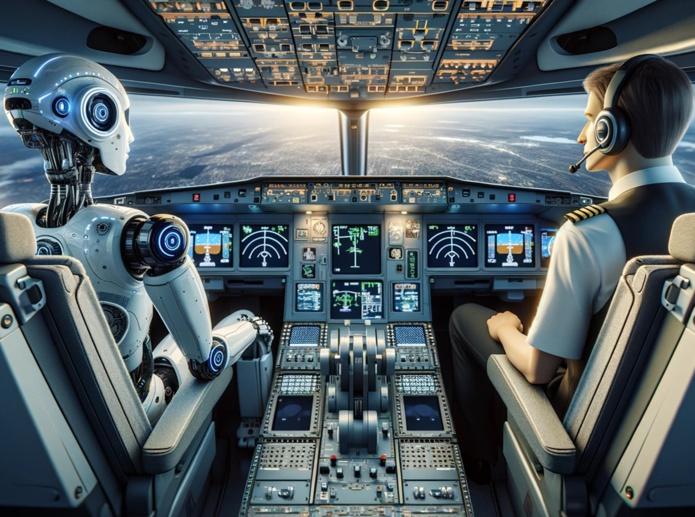
For decades, commercial aviation has relied on a carefully balanced relationship between human judgement and machine automation. Modern aircraft already operate with highly sophisticated autopilot systems, fly-by-wire controls and intelligent navigation technologies capable of handling large portions of a flight autonomously. But the next phase of aviation may push that relationship much further.
Artificial intelligence is no longer simply assisting pilots. It is beginning to actively fly aircraft itself.
According to recent reporting from CNN, aviation startup Merlin Labs has been conducting real-world flight demonstrations using AI-powered pilot systems capable of handling many traditional cockpit responsibilities autonomously. During one demonstration flight aboard a modified Cessna Caravan, the aircraft reportedly performed key flight operations while the human pilot kept their hands off the controls entirely.
The implications of that development extend far beyond experimental aviation.
Across the global aerospace industry, AI is increasingly being viewed as a potential solution to some of aviation’s most pressing challenges: pilot shortages, rising operational complexity, growing air traffic congestion and mounting pressure on safety systems.
And while fully pilotless passenger flights may still be years away, the technology is advancing faster than many expected.

Merlin Labs’ system reportedly goes far beyond conventional autopilot functionality. The AI platform uses natural language processing to interpret instructions from air traffic control while autonomously handling navigation and flight management tasks. According to CNN’s report, the system can even communicate over radio channels using synthetic voice technology while adapting to changing flight conditions in real time.
That represents a major shift in how aviation automation is evolving.
Traditional autopilot systems operate within tightly defined parameters. They excel at executing pre-programmed procedures but remain heavily dependent on human oversight and intervention. AI-assisted aviation systems, by contrast, are being designed to interpret broader situational contexts and respond dynamically to unpredictable scenarios.
In other words, aviation is beginning to move from automation toward autonomy.
This transition is happening at a particularly important moment for the airline industry.
Global demand for pilots continues rising rapidly as airlines expand fleets and air travel rebounds across major international markets. Boeing has previously estimated that the aviation sector will require more than 600,000 new pilots over the next two decades.
At the same time, air traffic systems are under increasing strain.
Recent years have seen mounting concern around near misses, operational overload and growing complexity within crowded airspace systems. Governments and aviation authorities are now actively exploring how artificial intelligence could reduce workload pressures while improving safety and operational efficiency.
Even regulators are beginning to embrace the conversation.
According to CNN’s reporting, US Transportation Secretary Sean Duffy has publicly discussed the role AI could play in modernising America’s aging air traffic infrastructure, while still emphasising that human oversight would remain central to aviation safety.
That distinction is critical.

7
Despite the excitement surrounding autonomous flight technology, the aviation industry remains deeply cautious about removing humans from the cockpit entirely. Commercial aviation operates under some of the strictest safety and regulatory standards in the world, and public trust remains essential.
Pilot unions have already signalled concerns about overreliance on automation.
The Air Line Pilots Association, representing more than 79,000 pilots across the United States and Canada, stated that technological advancements should support pilots rather than replace them.
Those concerns are not simply political or labour-related. They are also deeply operational.
One of the growing debates surrounding AI-assisted systems is the risk of “skill atrophy” — the possibility that excessive reliance on automation may gradually reduce human capability during critical situations. Recent academic research into shared AI control systems highlights this challenge directly, warning that operators can become less effective if autonomous systems consistently override or handle complex decision-making themselves.
Aviation has already experienced elements of this problem historically.
Modern aircraft automation has dramatically improved safety overall, but several high-profile aviation incidents over the past two decades have involved situations where pilots struggled to regain manual situational awareness after automation failures or unexpected flight conditions.
The next generation of AI systems therefore faces an enormous challenge: enhancing human performance without weakening human capability.
That is why many companies now describe their technology as “human-in-the-loop” rather than fully autonomous.
The goal, at least for now, is augmentation rather than replacement.
Merlin Labs itself has reportedly emphasised that fully pilotless passenger aircraft are still far away, framing its system instead as a collaborative cockpit technology designed to assist human crews and reduce workload.
That approach aligns with broader trends across aerospace and robotics.
Rather than pursuing pure autonomy immediately, many advanced AI systems are being developed around shared control models where humans maintain final authority while AI handles repetitive tasks, data interpretation and operational optimisation.

The military sector, however, is moving far faster.
Autonomous aircraft technologies are already being explored extensively within defence programmes worldwide. AI-assisted combat aircraft, autonomous drone formations and collaborative military aviation systems are rapidly advancing, supported by billions in defence investment.
That military development may ultimately accelerate commercial aviation adoption as technologies mature and regulatory confidence grows.
Cargo aviation is also expected to become an early proving ground for AI-powered aircraft operations. Freight carriers face fewer passenger perception challenges and often operate within more controlled operational environments, making them ideal candidates for gradual autonomy integration.
In many ways, aviation is following a pattern already seen across other industries.
Artificial intelligence is first being introduced as a decision-support layer before gradually taking on more operational responsibility over time. Cars, logistics systems, manufacturing operations and financial infrastructure have all experienced similar transitions.
Aircraft may simply be the next frontier.
Yet aviation carries uniquely high emotional and psychological stakes.
Passengers may comfortably trust AI to recommend music, optimise traffic routes or manage smart homes. Trusting AI at 35,000 feet is an entirely different proposition altogether.
That means public acceptance could become just as important as technical capability.
For now, the industry appears aware of that reality. Companies developing autonomous aviation systems are carefully positioning AI as a safety enhancement rather than a replacement for human expertise.
And there are genuine advantages.
AI systems do not experience fatigue, distraction or cognitive overload in the same way humans do. They can continuously process vast quantities of sensor data, monitor systems simultaneously and respond instantly to operational anomalies.
If implemented correctly, those capabilities could significantly improve aviation safety over time.
But aviation has always been built on layers of redundancy, trust and rigorous caution. Any meaningful transition toward AI-assisted or autonomous commercial flight will likely happen gradually over many years rather than through sudden disruption.
Still, the direction of travel now feels increasingly clear.
Artificial intelligence is no longer approaching aviation from the outside.
It is entering the cockpit itself.