



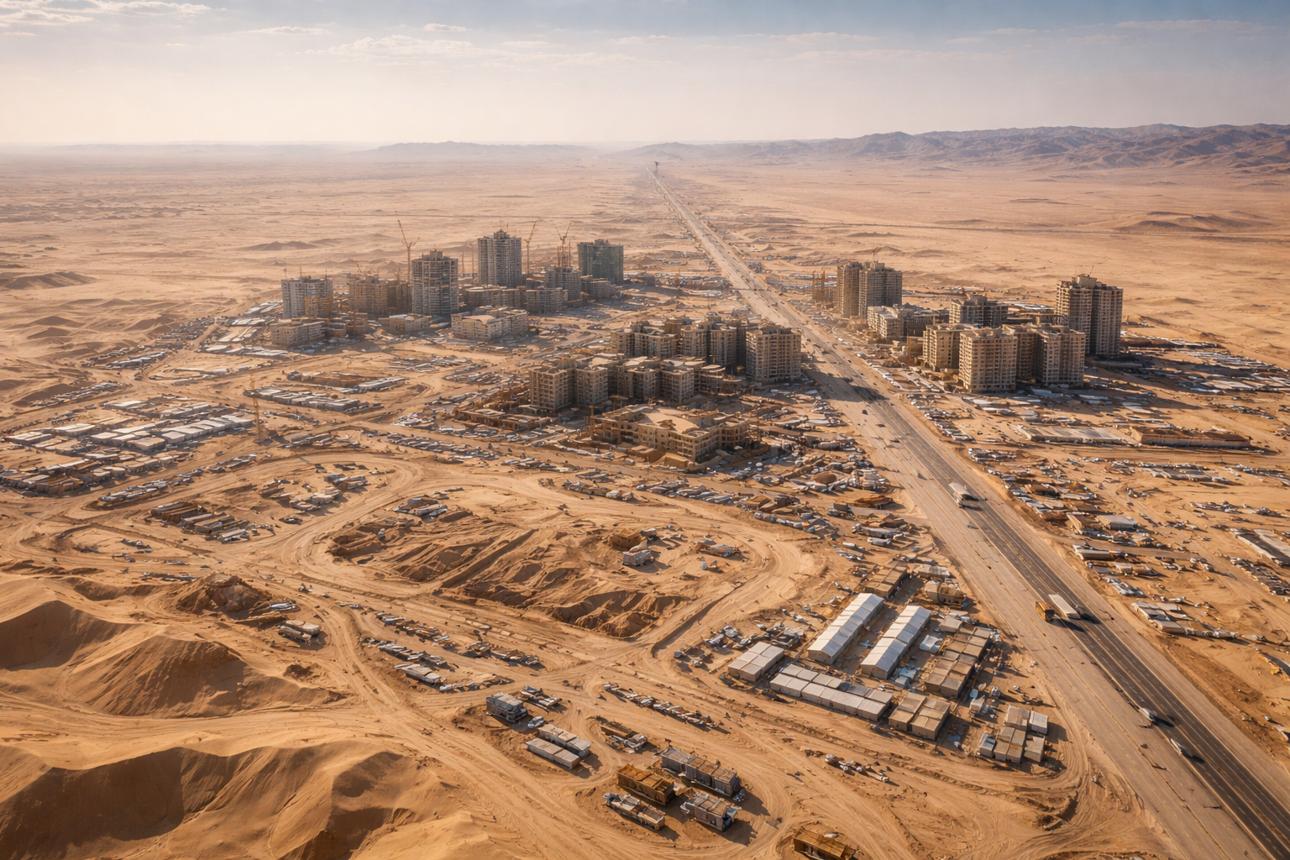
At first glance, it sounds like one of the world’s strangest trade stories. Saudi Arabia, home to vast deserts stretching across much of the Arabian Peninsula, imports sand from countries such as Australia to support its construction industry.
How can a nation surrounded by seemingly endless sand need to buy more from abroad?
The answer lies in a fascinating combination of geology, engineering and one of the largest construction booms in modern history. As Saudi Arabia accelerates projects such as NEOM, The Line, Qiddiya and the Red Sea Project, demand for construction materials continues to rise. The challenge is that not all sand is created equal.

The Problem With Desert Sand
The Arabian Peninsula contains some of the world’s most spectacular deserts, including the vast Empty Quarter, or Rub’ al Khali. Yet the sand found in these deserts is often unsuitable for concrete production.
Over thousands of years, desert sand grains are continuously shaped by wind. As the grains collide and move across dunes, their sharp edges become worn away. The result is smooth, rounded particles that look beautiful under a microscope but perform poorly in construction applications.
Concrete relies on sand grains locking together and bonding effectively with cement paste. Construction-grade sand typically comes from riverbeds, quarries, lakes or marine deposits where water erosion creates rough, angular particles. These irregular shapes interlock and produce stronger, more durable concrete structures.
Engineers often compare desert sand to millions of tiny ball bearings. Rather than gripping together, the grains slide past one another, creating weaker structural performance when used in large-scale concrete applications.
Building the Future Requires the Right Sand
For a country pursuing some of the world’s most ambitious infrastructure projects, material quality is critical.
Saudi Arabia’s Vision 2030 strategy includes the development of futuristic cities, tourism destinations, industrial zones and transport networks. These projects require enormous quantities of reinforced concrete capable of lasting for decades under demanding environmental conditions.
Projects such as NEOM and The Line demand millions of tonnes of construction materials. Using lower-quality aggregates simply is not an option when constructing high-rise buildings, transport systems and advanced urban infrastructure.
As a result, Saudi Arabia imports specific grades of construction sand despite possessing one of the world’s largest desert landscapes. According to trade data referenced by multiple reports, the kingdom imported construction-grade sand from Australia in 2023, highlighting the practical realities behind modern engineering requirements.

Australia’s Unexpected Role
Australia has become one of the world’s major exporters of industrial and construction-grade sand.
Unlike desert sand, Australian sand resources often originate from rivers, quarries and geological formations that produce the angular grain structures required for concrete manufacturing. This makes Australian exports attractive to rapidly developing Gulf economies.
What appears at first to be an economic contradiction is actually a straightforward example of resource quality outweighing resource quantity. Saudi Arabia has vast amounts of sand, but much of it is not the type needed for large-scale construction.
The situation is similar across other Gulf nations. Major developments in the United Arab Emirates have also relied on imported construction-grade sand, despite the country’s own extensive desert environment.
The Growing Global Sand Crisis
Saudi Arabia’s imports also highlight a broader issue affecting the construction industry worldwide.
Sand is the second most consumed natural resource on Earth after water. The world uses tens of billions of tonnes every year in concrete, glass manufacturing, land reclamation and infrastructure development. High-quality construction sand is becoming increasingly valuable as demand continues to rise.
Environmental concerns surrounding river dredging and coastal extraction have led governments and researchers to search for alternatives. Many experts now view construction-grade sand as a strategic resource that will play an increasingly important role in future development planning.

Searching for Alternatives
Saudi Arabia is not simply relying on imports. Researchers and industry leaders are exploring several alternatives that could reduce dependence on foreign supplies.
One solution involves manufactured sand, often known as M-sand, produced by crushing rock into precisely engineered particles. Because the grains are created mechanically, their size and shape can be tailored for construction use.
Other approaches include recycling construction waste into aggregates, developing advanced concrete formulations and investing in new material technologies that reduce overall sand requirements.
While these solutions continue to evolve, imported construction-grade sand remains an important component of the country’s ongoing development strategy.
More Than Just a Curious Fact
The idea of a desert nation importing sand often appears as a quirky headline, but it reveals something much deeper about modern construction and resource management.
Saudi Arabia’s sand imports are not a sign of scarcity. They are a reminder that quality matters as much as quantity. The smooth, wind-shaped grains covering the Arabian deserts simply cannot provide the structural performance required for the skyscrapers, transport networks and futuristic cities envisioned under Vision 2030.
As the kingdom continues to transform its economy and build some of the most ambitious projects on Earth, the story of imported sand demonstrates how even the most abundant natural resources can become highly specialised commodities. In the world of modern engineering, having sand is one thing. Having the right sand is something else entirely.