



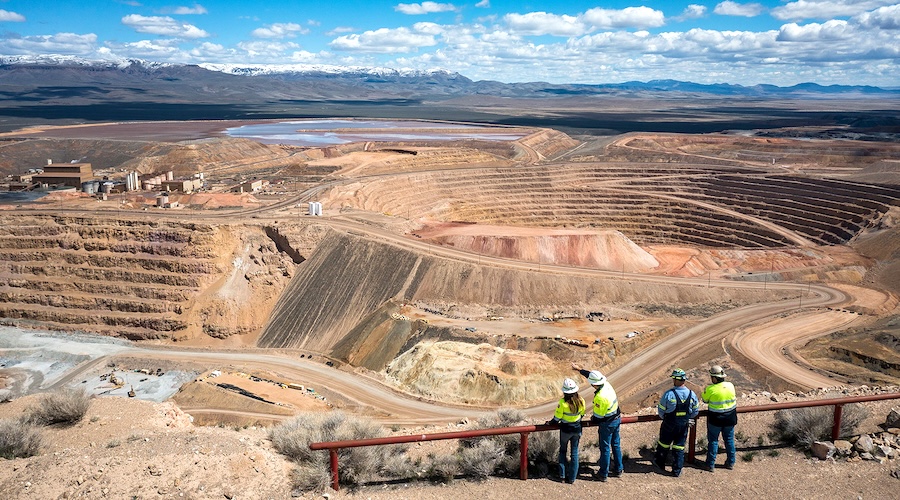
Gold mining is no longer defined by individual deposits. It is defined by scale.
As global demand for gold continues to rise, driven by central bank accumulation, investor demand and macroeconomic uncertainty, production has reached record levels. Global mine output hit approximately 3,661 tonnes in 2024, underscoring the growing strategic importance of the sector.
At the centre of that supply chain sits a relatively small group of ultra-large mining operations. These are not simply mines. They are industrial ecosystems, producing millions of ounces annually and shaping the economics of the global gold market.
The World’s Largest Gold Mines
The latest global ranking highlights a clear concentration of production among a handful of mega-assets.
The top five are led by:
- Nevada Gold Mines (USA) – the world’s largest gold mining complex, producing approximately 2.7 million ounces annually
- Muruntau (Uzbekistan) – one of the largest deposits globally, with vast reserves and output approaching 2.7 million ounces
- Grasberg (Indonesia) – a copper-gold giant producing over 1.8 million ounces
- Olimpiada (Russia) – a cornerstone asset for Polyus, delivering over 1.4 million ounces
- Almalyk Complex (Uzbekistan) – a rapidly expanding Central Asian operation exceeding 1.1 million ounces
These operations alone account for a significant share of global production, illustrating just how concentrated gold supply has become at the top end of the market.
Geography of Gold Power
The distribution of the world’s largest gold mines reflects a truly global industry.
Major operations span:
- North America – dominated by Nevada’s integrated mining complexes
- Central Asia – with Uzbekistan emerging as a critical production hub
- Southeast Asia – anchored by Indonesia’s Grasberg
- Russia – home to some of the highest-grade, large-scale deposits
- Africa and Oceania – including assets such as Kibali, Lihir and Boddington
This geographic spread is not incidental. It reflects the geological reality of gold formation, but also the geopolitical complexity of securing long-term supply.
Increasingly, gold production is tied not just to geology, but to jurisdictional stability, infrastructure and access to capital.
What Defines a “Mega Mine”
The world’s largest gold mines share a set of defining characteristics.
They operate at a scale that fundamentally changes the economics of extraction:
- Production volumes exceeding one million ounces annually
- Massive open-pit or hybrid underground operations
- Advanced processing facilities handling vast ore throughput
- Integration of automation and digital systems
These sites process tens of thousands of tonnes of material daily, often employing thousands of workers and leveraging increasingly sophisticated technology to maintain efficiency and safety.
In this context, scale is not simply about output. It is about cost structure.
Larger operations benefit from economies of scale, enabling lower per-ounce production costs and greater resilience against price volatility.
The Strategic Role of Gold Mining
Gold’s role in the global economy has evolved.
Traditionally viewed as a store of value, it is now increasingly treated as a strategic asset. Central banks continue to accumulate reserves, while investors turn to gold as a hedge against inflation, currency volatility and geopolitical risk.
This has direct implications for mining.
Large-scale operations are no longer just commercial assets. They are strategic infrastructure, underpinning national reserves, global liquidity and financial stability.
Consolidation and Control
One of the most notable trends in gold mining is consolidation.
The world’s largest mines are increasingly operated by joint ventures or major global players. Nevada Gold Mines, for example, is a partnership between Barrick and Newmont, combining multiple assets into a single integrated complex.
This model reflects a broader industry shift:
- Shared capital investment
- Operational efficiency through consolidation
- Reduced competition for premium assets
In effect, the industry is moving towards fewer, larger, more integrated operations.
The Future of Gold Production
The trajectory of gold mining is clear.
Future supply growth will not come from a proliferation of new small mines, but from the expansion, optimisation and extension of existing mega-assets, alongside a limited number of large-scale new developments.
At the same time, pressure is mounting around:
- Environmental impact
- Energy consumption
- Social licence to operate
- Regulatory scrutiny
The next generation of gold mining will therefore be defined not just by scale, but by sustainability.
A Market Defined by Scale
The world’s largest gold mines are more than production sites.
They are the backbone of a global industry that sits at the intersection of finance, geopolitics and resource security.
As demand continues to rise, the importance of these mega-operations will only increase. Not simply as suppliers of gold, but as strategic assets shaping the future of global markets.
In gold mining, size is no longer just an advantage.
It is the model.