



There is a quiet but decisive shift taking place in manufacturing. For years, artificial intelligence has been positioned as a tool for insight, optimisation and incremental efficiency. At Hannover Messe 2026, that framing begins to change. What NVIDIA and its partners are demonstrating is not AI as an overlay, but AI as infrastructure, embedded directly into the design, operation and orchestration of industrial systems.
The message is clear. Manufacturing is no longer asking whether to adopt AI, but how quickly it can scale it. Across industries facing labour shortages, compressed design cycles and increasing operational complexity, AI is moving from pilot projects into production environments.
From Pilot Projects to Production Systems
At the centre of NVIDIA’s showcase is a shift from experimentation to execution. AI is no longer confined to dashboards or analytics layers. It is actively running workflows, controlling systems and enabling real-time decision-making across factories.
Demonstrations at Hannover Messe highlight how AI agents, robotics and accelerated computing are being deployed directly into manufacturing environments. These systems are capable of handling tasks such as quality inspection through computer vision, orchestrating robot fleets and performing root-cause analysis on production issues in real time.
The implication is significant. Manufacturing is becoming one of the first sectors where “agentic AI”, systems that act rather than advise, is reaching production scale.
The Rise of Industrial AI Infrastructure

If AI is to operate at industrial scale, it requires a different kind of foundation. This is where NVIDIA’s concept of the Industrial AI Cloud becomes central. Built in Germany by Deutsche Telekom using NVIDIA infrastructure, it represents one of Europe’s largest “AI factories”, designed to support real-time simulation, robotics and large-scale AI workloads.
This is not simply cloud computing applied to manufacturing. It is a sovereign, industrial-grade platform intended to support everything from digital twins to autonomous robotics across entire supply chains. Companies including SAP, Siemens and Agile Robots are already using the platform to run AI-driven simulations and production systems at scale.
The shift here is subtle but important. AI is no longer an application. It is becoming a layer of infrastructure, as fundamental as electricity or connectivity within industrial environments.
Engineering in Real Time
One of the most immediate impacts of this shift is in engineering itself. Traditionally, product design and testing have been constrained by time, cost and physical limitations. AI-driven simulation changes that equation.
At Hannover Messe, partners including Cadence, Dassault Systèmes and Siemens are integrating NVIDIA technologies such as CUDA-X and Omniverse to enable real-time, physics-based simulation.
This allows engineers to test, iterate and optimise designs virtually before anything is built. What once took hours or days can now be completed in minutes, fundamentally accelerating product development cycles and reducing reliance on physical prototypes.
Digital Twins and the Factory as Software

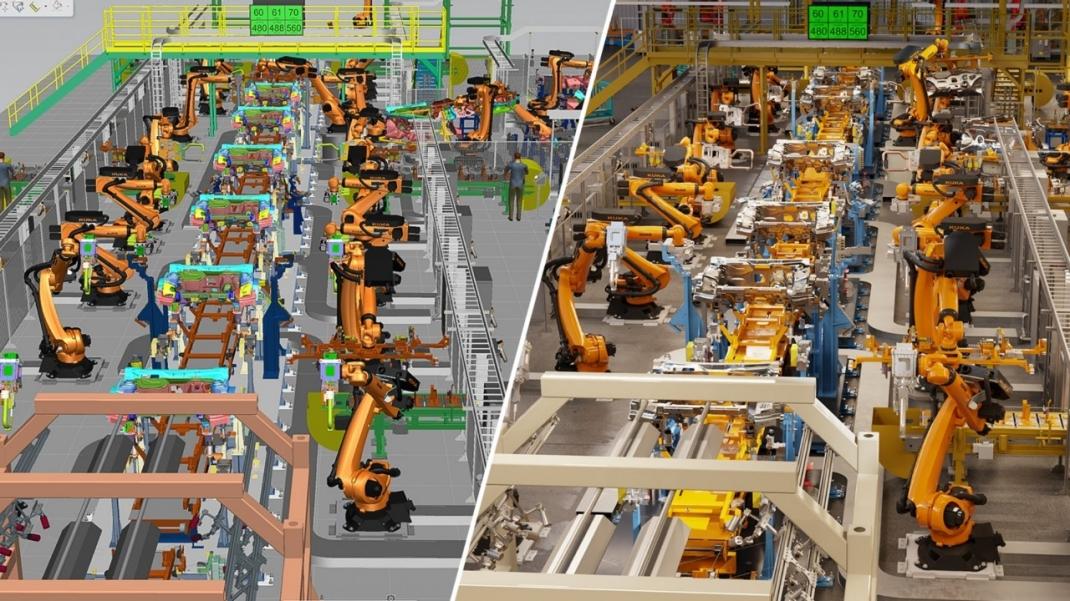
Perhaps the most transformative concept on display is the rise of factory-scale digital twins. These are not simple visual models, but fully functional virtual replicas of real-world operations, capable of simulating production processes, testing scenarios and optimising workflows continuously.
Built using technologies such as NVIDIA Omniverse and OpenUSD, these digital twins allow manufacturers to design, stress-test and refine operations in real time.
The effect is a shift towards software-defined manufacturing, where factories can be adjusted, optimised and reconfigured digitally before changes are implemented physically. This reduces risk, increases efficiency and enables a level of operational agility that traditional manufacturing systems have struggled to achieve.
Robotics, AI Agents and the Physical Layer
Beyond simulation, the physical layer of manufacturing is also being redefined. AI-powered robots and autonomous systems are becoming more capable, more adaptive and more integrated into production environments.
From humanoid robots operating on factory floors to AI agents coordinating logistics and assembly processes, the line between digital intelligence and physical execution is increasingly blurred.
This convergence is what NVIDIA refers to as “physical AI”, a model where intelligent systems are not just analysing data, but acting within real-world environments.
A Competitive Imperative, Not an Innovation Cycle
What emerges from Hannover Messe is not a vision of the future, but a statement about the present. Industrial AI is no longer experimental. It is becoming a competitive requirement.
Manufacturers are under pressure to improve efficiency, reduce costs and respond to increasingly volatile supply chains. AI offers a way to meet those demands, but only if it can be deployed at scale and integrated into core operations.
This is why the focus has shifted so quickly from pilots to production. The value is no longer theoretical. It is measurable, whether in reduced lead times, improved quality or increased throughput.
From Automation to Autonomy
The deeper implication of NVIDIA’s showcase is that manufacturing is moving beyond automation towards autonomy. Traditional automation relies on predefined rules and processes. Autonomous systems adapt, learn and optimise continuously.
By combining AI agents, real-time simulation, robotics and industrial-scale infrastructure, manufacturers are beginning to build systems that can operate with a degree of independence previously unseen in industrial environments.
The Factory of the Future, Already Underway
Hannover Messe has long been a window into industrial transformation. This year, it feels less like a preview and more like a confirmation.
The factory of the future is not a concept waiting to be realised. It is already being built, tested and deployed.
And if the trajectory continues, manufacturing may become the sector where AI’s transition from assistance to autonomy is not just visible, but definitive.