



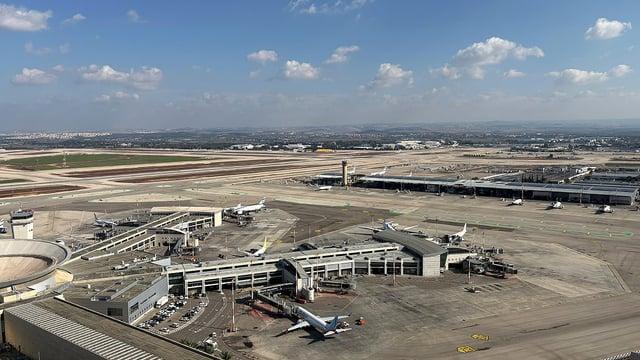
Israel’s main international gateway is facing mounting operational pressure as an increasing number of US military aircraft stationed at Ben Gurion Airport begin affecting civilian air travel, airline operations and passenger costs. According to reports emerging from Israel’s Civil Aviation Authority, the growing presence of American refuelling aircraft and military logistics planes is significantly limiting commercial aviation activity at the country’s busiest airport.
The situation highlights how geopolitical tensions are increasingly colliding with civilian infrastructure across the Middle East. While Ben Gurion Airport has historically operated as one of the region’s busiest commercial aviation hubs, ongoing regional instability linked to the conflict with Iran has transformed the airport into a far more strategically sensitive environment.
Civil Aviation Authority chief Shmuel Zakai reportedly warned Israeli officials that Ben Gurion is effectively becoming a “US military base with limited civilian aircraft operations,” arguing that the concentration of American aircraft is discouraging foreign airlines from returning while also increasing operating costs for Israeli carriers.

6
At the centre of the issue is space. Airports operate through highly coordinated gate allocation, parking positions and ground movement systems, and military aircraft often occupy significantly larger operational footprints than standard commercial jets. Reports suggest US Air Force refuelling aircraft currently stationed at Ben Gurion are taking up substantial apron and parking capacity, limiting the number of civilian aircraft able to operate efficiently from the airport.
For airlines, the impact is becoming increasingly commercial.
Israeli carriers including El Al, Arkia and Israir are already operating under heightened wartime restrictions following months of regional instability and disrupted flight schedules. Several airline executives have warned that restricted parking availability and operational limitations are directly affecting flight capacity and pushing costs higher.
Israir CEO Uri Sirkis reportedly stated that the airline, which would normally keep 17 aircraft parked overnight at Ben Gurion, is currently only permitted to keep four at the airport. That reduction creates logistical complications while also limiting scheduling flexibility and increasing operational costs for airlines already operating under difficult conditions.
The consequences extend beyond airlines themselves. Aviation officials are warning that reduced flight availability and higher operational expenses will likely translate directly into higher ticket prices for travellers. Foreign carriers have also been slower to fully restore operations into Israel amid continued uncertainty surrounding regional security conditions.
The aviation sector has already experienced severe disruption throughout 2026.
Following escalations involving Iran earlier this year, Israel temporarily closed its airspace entirely while airlines evacuated aircraft abroad and suspended commercial operations. Even after partial reopening phases, outbound passenger caps, reduced frequencies and temporary flight restrictions continued affecting operations at Ben Gurion for months.
This latest development reflects how aviation infrastructure increasingly becomes intertwined with geopolitical strategy during periods of conflict. Airports are not simply transport hubs. They also serve as strategic logistical assets capable of supporting military deployments, aerial refuelling operations and rapid force projection.

The broader implications are significant because Ben Gurion Airport remains central to Israel’s international connectivity and tourism economy. The airport handled more than 19 million passengers during 2025, making it one of the busiest aviation hubs in the region. Any prolonged operational limitations therefore create ripple effects across tourism, business travel and wider economic activity.
The issue also exposes the growing strain placed on civilian infrastructure during prolonged geopolitical crises. While military operations require strategic flexibility, civilian aviation systems depend heavily on predictability, scheduling efficiency and stable operational environments. Combining both within a constrained airport environment creates inevitable tension.
Israeli officials have reportedly urged consideration of relocating some American military aircraft to dedicated military airbases or alternative facilities such as Ramon Airport in order to free up capacity for civilian aviation.

At the same time, the increased US military presence itself reflects the strategic importance of the region amid ongoing tensions. Images circulating across international media in recent weeks have shown large numbers of American refuelling aircraft positioned at Ben Gurion as part of broader US support operations connected to regional security developments.
For passengers, however, the practical consequences are becoming increasingly visible. Reduced flight supply, limited foreign carrier availability and higher operational costs all contribute toward more expensive and less flexible travel options at a time when Israeli aviation is already under pressure.
The situation ultimately demonstrates how modern aviation is deeply connected to wider geopolitical realities. Airports once designed almost entirely around civilian mobility now increasingly operate within environments shaped by security concerns, military logistics and geopolitical risk.
And as regional tensions continue influencing aviation operations across the Middle East, balancing military necessity with civilian connectivity may become one of the defining infrastructure challenges facing airports like Ben Gurion Airport in the years ahead.