




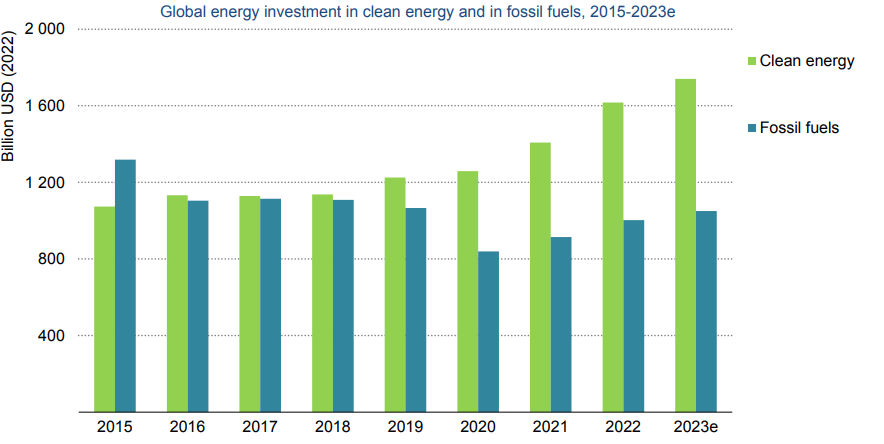
The International Energy Agency (IEA) revealed in its latest World Energy Investment 2025 report that global investment in clean energy technologies and infrastructure is set to reach approximately $2.2 trillion this year—twice the amount allocated to fossil fuels, which stand at roughly $1.1 trillion . With total energy investment projected at $3.3 trillion, this represents a pivotal shift in how capital is flowing into energy sectors .
“Electrons Outpacing Molecules”
IEA Executive Director Dr Fatih Birol commented on the trend:
“For every dollar going to fossil fuels today, almost two dollars are invested in clean energy… Electricity investments are significantly higher than all fossil fuel investments put together.”
Birol emphasized that clean energy’s dominance is driven by cost efficiency, energy security concerns, and industrial strategic competition.
Where the Money Is Going
Key areas seeing the bulk of investment include:
- Solar PV: Projected at $450 billion, making it the top clean-energy destination globally .
- Battery storage: Investment expected to reach $66 billion, supporting grid flexibility
- Nuclear power: With a 50% increase over five years, topping $70 billion in 2025 .
- Electricity grids: Currently funded at $400 billion, though grid expansion still trails behind generation capacity.
Uneven Growth in Fossil Fuel Investment
While clean energy leads, fossil fuel investment patterns show mixed trends:
- Oil & Gas: Globally, oil and gas investment is down 6%, marking the first annual decline since before the pandemic
- Coal Projects: China and India are supporting new coal capacity, with approvals at their highest since 2015
Global Disparity and Grid Bottlenecks
Despite the overall growth, disparities emerge:
- Clean energy capital is concentrated in China, the EU, and the U.S., which together account for over 70 % of global investment
- Developing countries receive only about 15 % of total clean energy funding, severely underfunding their transition needs.
- Grid investments lag behind generation, risking stability as more renewables come online .
What This Means for Tech & Energy Ecosystems
For tech-centric readers, these investment trends highlight several opportunities and challenges:
- Battery & storage innovation: As investment targets $66 billion, there is room for game-changing enhancements in capacity, cost, and lifecycle.
- Grid-tech ecosystems: Smart grids, IoT monitoring, and digital substations are crucial to accommodate renewables at scale.
- Clean tech software platforms: Tracking funding flows, managing carbon reductions, and modelling climate impact are becoming high-growth SaaS niches.
- Electrification: With EVs, heat pumps, and data-centre electrification drawing significant capital, systems integration and energy management tech will be central to infrastructure builds.
Looking Ahead
- Clean energy investment needs to double again to align with the net-zero trajectory needed by 2030 as per IEA’s roadmap
- Grid modernization must accelerate to avoid bottlenecks in renewable integration.
- Emerging markets require targeted financing—especially concessional capital—to match energy demand growth and development needs.
TL;DR
- Clean energy sees $2.2 trillion investment in 2025—double that of fossil fuels.
- Solar, storage, nuclear, and grids dominate spending.
- Fossil fuel investment declines—but new coal in Asia persists.
- Capital remains unevenly distributed; tech flows being channeled into advanced economies and low-carbon solutions.
- Massive potentials exist in storage, grid digitization, software, and electrification tech.