




Energy costs are climbing while supply chain disruptions threaten manufacturing and energy sector margins. You need practical ways to reduce operational expenses and improve agility without overhauling your entire infrastructure. This guide walks you through proven strategies to integrate energy efficiency and digital tools into your supply chains, delivering measurable cost savings and resilience you can start implementing today.
Table of Contents
- Understanding Cost Drivers and Energy Impact
- Prerequisites: What You Need Before You Start
- Leveraging Digital Technologies for Efficiency
- Integrating Energy Efficiency in Supply Chains
- Designing Resilient Supply Chains
- Building Workforce Capabilities and Training
- Common Mistakes and Failure Points
- Expected Results and Measurable Outcomes
- Explore Solutions to Revolutionize Your Supply Chain
- Frequently Asked Questions
Key Takeaways
| Point | Details |
|---|---|
| Energy costs represent up to 35% of manufacturing expenses | Targeting energy efficiency directly impacts bottom line profitability. |
| Digital tools boost responsiveness by up to 40% | AI analytics and automation enable faster, smarter supply chain decisions. |
| Energy-efficient tech cuts costs by 25% | Integrating renewables and storage systems optimizes consumption and reduces expenses. |
| Workforce training drives sustained gains | Skilled teams ensure digital and energy tools deliver long-term value. |
| Resilient supply chains reduce disruption impact over 50% | Diversification and risk mitigation protect operations from volatility. |
Understanding Cost Drivers and Energy Impact
Energy expenses often account for a massive portion of your operational budget. In fact, energy costs represent up to 35% of total costs in key manufacturing sectors. This makes energy consumption one of the most significant factors influencing your supply chain competitiveness.
Global energy efficiency improvements are lagging behind climate targets, putting additional pressure on operational costs. When energy prices spike or supply becomes unreliable, your entire supply chain feels the impact. Understanding these cost drivers is essential before you can design targeted efficiency improvements.
Here are the primary energy-related cost drivers affecting your supply chain:
- Direct energy consumption in production facilities and warehouses
- Transportation and logistics fuel costs across your distribution network
- Energy-intensive processes in raw material extraction and processing
- Cooling, heating, and climate control for inventory storage
- Equipment operation and maintenance energy requirements
Recognizing how energy flows through your supply chain lets you identify where efficiency improvements will deliver the biggest returns. The energy cost challenges in manufacturing are not going away, so your strategy must address them head on.
Focusing on energy efficiency research helps you benchmark your operations against industry standards and identify practical improvement opportunities.
Prerequisites: What You Need Before You Start
Before launching efficiency initiatives, you need the right foundation. Jumping into technology upgrades without proper groundwork wastes resources and creates frustration.
Digital infrastructure forms the backbone of modern supply chain efficiency. You need integrated ERP and SCM software systems to capture data, track performance, and coordinate actions across your network. Without these systems, you cannot measure progress or optimize operations effectively.
Baseline assessments are equally critical. You must document current energy consumption patterns, supply chain performance metrics, and operational bottlenecks. This baseline becomes your reference point for measuring improvement. Walking into efficiency projects blind means you cannot prove ROI or adjust tactics as needed.
Workforce readiness determines whether your efficiency investments succeed or stall. Your team needs training on new digital tools, energy management practices, and continuous improvement methodologies. Without committed workforce development, even the best technology sits underutilized.
Essential prerequisites before starting efficiency improvements:
- Integrated ERP and supply chain management software platforms
- Documented baseline energy consumption and performance metrics
- Committed budget for workforce training and skill development
- Executive sponsorship ensuring cross-functional coordination
- Clear KPIs linking efficiency improvements to business outcomes
Pro Tip: Start with a pilot program in one facility or supply chain segment. Prove the concept, build internal expertise, and then scale. This reduces risk and builds momentum for broader adoption.
Getting these prerequisites right avoids costly missteps and builds organizational capacity for sustained improvement. Skipping preparation leads to implementation failures that discourage future efficiency efforts.
Leveraging Digital Technologies for Efficiency
Digital tools transform how you manage supply chain operations. AI-driven analytics, automation, and real-time visibility platforms let you respond faster to disruptions and optimize resource allocation.

AI analytics improve demand forecasting accuracy, helping you avoid both stockouts and overstocking. Machine learning models analyze historical patterns, market signals, and external factors to predict demand shifts before they impact operations. AI-driven analytics boost supply chain responsiveness by up to 40%, enabling proactive rather than reactive management.
Automation enhances logistics and inventory agility. Automated warehouse systems, robotic process automation for order fulfillment, and intelligent routing algorithms reduce delays and labor costs. These tools work continuously, adjusting to real-time conditions without manual intervention.
Real-time visibility platforms give you a complete view of your supply chain from raw materials to final delivery. IoT sensors, GPS tracking, and cloud dashboards let you monitor shipments, inventory levels, and equipment status instantly. When disruptions occur, you can reroute shipments, adjust production schedules, or communicate with customers immediately.
Key digital technologies driving supply chain efficiency:
- AI and machine learning for demand forecasting and risk prediction
- Warehouse automation and robotics for faster, accurate fulfillment
- IoT sensors providing real-time asset and inventory tracking
- Cloud-based platforms enabling collaborative planning across partners
- Predictive maintenance tools reducing equipment downtime
The digital transformation in manufacturing supply chains is accelerating as companies recognize competitive advantages from technology adoption.
Pro Tip: Integrate your digital tools into a unified platform rather than deploying point solutions. Fragmented systems create data silos that limit visibility and slow decision making.
Investing in digital supply chain management impact studies helps you understand which technologies deliver the best ROI for your specific operations.
Integrating Energy Efficiency in Supply Chains
Reducing energy consumption across your supply chain cuts costs and builds resilience. Practical energy efficiency measures pay for themselves through lower utility bills and improved operational stability.
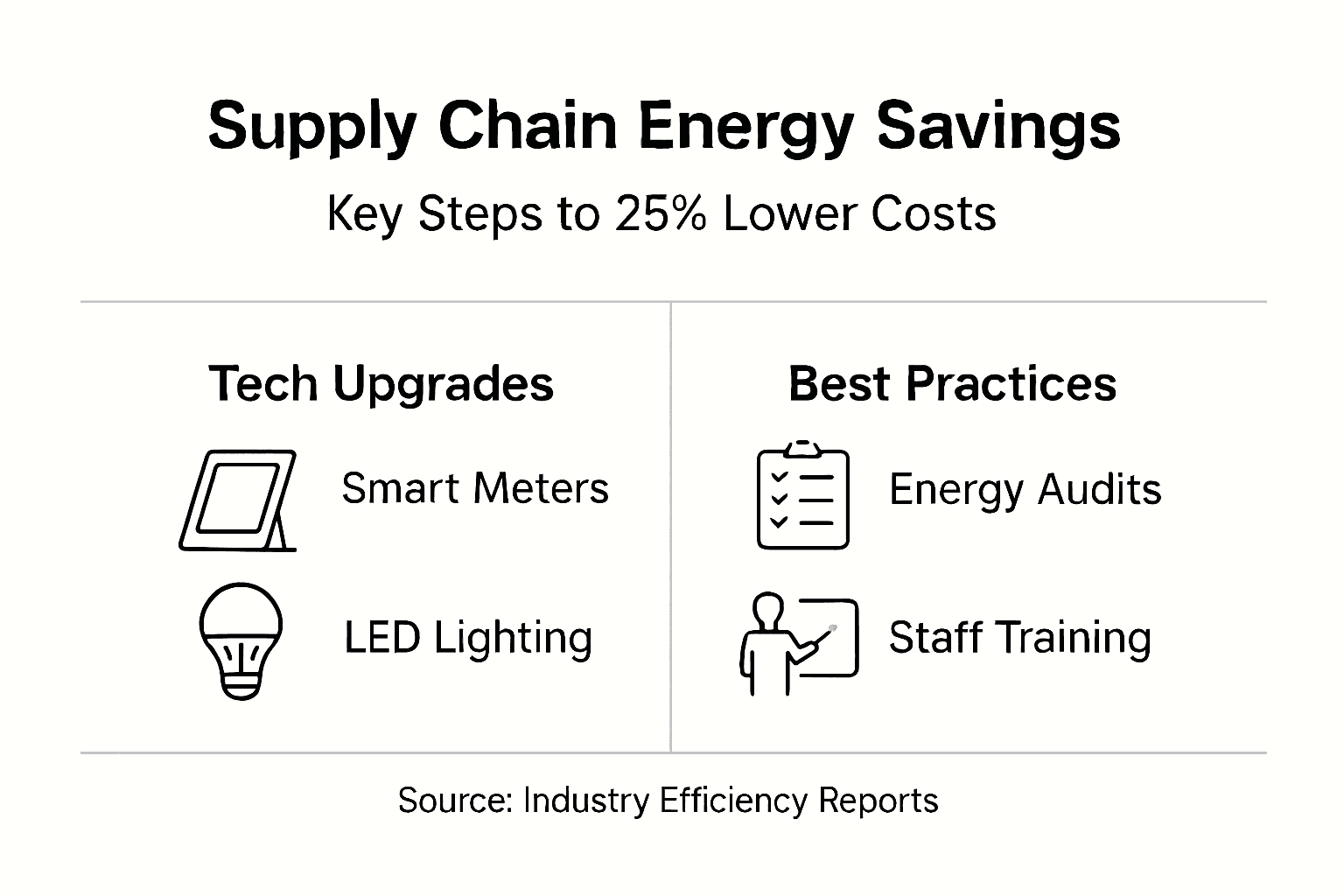
Energy storage systems combined with renewable energy sources optimize when and how you consume power. Integrating ESS with renewables optimizes energy use, reducing costs by up to 25%. Battery storage lets you shift consumption to off-peak hours when electricity rates are lower, and buffers against grid instability.
Advanced energy-saving technologies applied across manufacturing, warehousing, and transportation operations yield significant reductions. Energy-efficient technology adoption can reduce operational energy use by up to 30%. LED lighting, high-efficiency HVAC systems, electric vehicles for logistics, and smart building controls all contribute to lower consumption.
Key energy efficiency measures for supply chain operations:
- Install solar panels and battery storage at facilities
- Upgrade to energy-efficient equipment and lighting systems
- Implement smart energy management systems with real-time monitoring
- Transition fleet vehicles to electric or hybrid models
- Optimize facility design for natural lighting and passive climate control
- Schedule energy-intensive operations during off-peak rate periods
| Aspect | Traditional Supply Chain | Energy-Optimized Supply Chain |
|---|---|---|
| Energy Source | Grid-dependent, fossil fuel transport | Renewables with storage, electric fleet |
| Consumption Monitoring | Monthly utility bills | Real-time smart meters and dashboards |
| Equipment Efficiency | Standard industrial equipment | High-efficiency certified systems |
| Operational Scheduling | Continuous operations | Demand-responsive, off-peak optimization |
| Cost Predictability | Volatile, market-driven | Stable, partially self-generated |
Energy efficiency integrations support both immediate cost savings and long-term supply chain resilience. When energy prices spike or supply tightens, your operations remain stable while competitors struggle.
Exploring energy efficiency tech integration research and advanced energy-saving technologies helps you identify the best solutions for your specific operational context.
Designing Resilient Supply Chains
Resilience protects your operations from disruptions that can halt production and damage customer relationships. Building supply chains that withstand volatility requires intentional design focused on diversification and risk mitigation.
Supply chain disruptions and energy supply volatility create urgent needs for resilience strategies. Geopolitical tensions, climate events, and market shocks affect 50 to 70% of companies annually. Without resilience planning, these disruptions cascade through your operations.
Diversifying your supplier base reduces dependency on single sources. Multi-sourcing critical materials and components means that when one supplier faces issues, alternatives keep your operations running. Geographic diversification also protects against regional disruptions like natural disasters or political instability.
Programmatic finance models help smaller suppliers in your network improve their robustness. When your suppliers lack capital for inventory, equipment upgrades, or working capital, your entire supply chain becomes brittle. Supply chain finance programs that improve supplier liquidity benefit everyone.
Strategies for building resilient supply chains:
- Develop relationships with multiple suppliers for critical inputs
- Diversify supplier locations across different geographic regions
- Maintain strategic inventory buffers for high-risk components
- Implement supply chain finance programs supporting supplier health
- Build contractual flexibility allowing volume and timing adjustments
- Monitor geopolitical and climate risks affecting supplier regions
The focus on supply chain risk mitigation is growing as companies recognize that resilience directly impacts competitiveness. Effective logistics resilience strategies balance cost efficiency with redundancy.
Resilience is not just about surviving disruptions. It positions you to capitalize on competitor struggles during volatile periods, gaining market share while others scramble to recover.
Studying supply chain resilience research provides frameworks and case studies to guide your resilience investments.
Building Workforce Capabilities and Training
Your people determine whether efficiency initiatives succeed or fail. Technology and processes only deliver value when your workforce knows how to use them effectively.
Addressing skills gaps is critical for adopting digital tools and energy-efficient practices. Investing upfront in workforce digital skills and energy management capabilities is essential for successful supply chain modernization. Without training, expensive technology sits underutilized or misused.
Continuous training programs facilitate ongoing technology and process improvements. One-time training sessions are insufficient. As systems evolve and new capabilities emerge, your team needs regular skill updates. Embedding learning into daily operations through mentoring, knowledge sharing, and hands-on practice creates lasting capability.
A skilled workforce correlates directly with measurable performance gains. Teams fluent in data analytics, energy management, and digital tools identify improvement opportunities faster and implement solutions more effectively. This translates to lower costs, higher quality, and better customer service.
Workforce development priorities for supply chain efficiency:
- Digital literacy covering ERP, SCM, and analytics platforms
- Energy management fundamentals and efficiency best practices
- Data analysis skills for interpreting performance metrics
- Problem-solving methodologies like Lean and Six Sigma
- Change management skills for leading improvement initiatives
- Cross-functional collaboration and communication capabilities
Investment in workforce capabilities ensures sustainability of your efficiency initiatives. Technology depreciates and processes evolve, but a capable, adaptable workforce continues driving improvement regardless of changing circumstances.
Exploring workforce training for supply chain programs helps you design effective development strategies aligned with your operational needs.
Common Mistakes and Failure Points
Even well-intentioned efficiency initiatives stumble when common mistakes undermine implementation. Recognizing these pitfalls helps you avoid wasted resources and failed projects.
Overstocking as a risk response wastes capital and reduces liquidity. When faced with supply uncertainty, 60% of supply chain leaders reported overstocking, tying up cash in excess inventory. This creates new problems including storage costs, obsolescence risk, and working capital constraints.
Fragmented financing limits your smaller suppliers’ ability to invest in capacity upgrades or efficiency improvements. When suppliers lack access to affordable capital, they cannot modernize operations or maintain adequate inventory. This fragility ripples through your supply chain during disruptions.
Ignoring workforce training reduces adoption rates for digital tools and energy improvements. Employees resist change when they lack skills or understanding. Even the best technology fails without user buy-in and competence.
Common efficiency initiative mistakes to avoid:
- Overstocking inventory as a crude hedge against disruption
- Failing to support supplier financial health and modernization
- Deploying technology without adequate workforce training
- Pursuing efficiency gains without measuring baseline performance
- Ignoring cross-functional coordination leading to siloed improvements
- Expecting immediate results rather than planning for gradual gains
Adopting AI-driven demand forecasting reduces overstocking by improving prediction accuracy. Programmatic supply chain finance models give suppliers affordable capital access, strengthening the entire network. Committed training programs ensure your team can operate and optimize new systems.
Learning from common supply chain mistakes documented in industry research helps you avoid repeating costly errors that delay or derail your efficiency improvements.
Expected Results and Measurable Outcomes
Understanding realistic performance benchmarks helps you set appropriate goals and measure success. Efficiency initiatives deliver measurable improvements when implemented systematically.
Energy cost reductions up to 25% are achievable through integrated efficiency measures combining renewables, storage, and smart consumption management. These savings flow directly to your bottom line, improving margins without requiring revenue growth.
Digital tools improve supply chain responsiveness by up to 40%, enabling faster reactions to demand changes and disruptions. Reduced lead times, better inventory turns, and fewer stockouts translate to improved customer satisfaction and competitive advantage.
Resilient supply chain designs reduce disruption impacts in over 50% of cases. Diversified suppliers, strategic buffers, and flexible contracts mean that when disruptions occur, your operations continue while competitors scramble.
| Metric | Traditional Performance | Improved Performance |
|---|---|---|
| Energy Cost as % of Total | 30-35% | 20-25% |
| Supply Chain Responsiveness | Baseline | +30-40% improvement |
| Disruption Recovery Time | 4-6 weeks | 1-2 weeks |
| Demand Forecast Accuracy | 65-75% | 85-90% |
| Inventory Turnover | 4-6 times/year | 8-12 times/year |
These improvements compound over time. Lower energy costs and better responsiveness free up capital for growth investments. Enhanced resilience protects market share during volatile periods.
Results vary based on starting conditions, industry sector, and implementation rigor. Companies starting with older infrastructure and processes see larger gains. Continuous measurement and adjustment maximize returns from your efficiency investments.
Explore Solutions to Revolutionize Your Supply Chain
You have seen how energy efficiency and digital tools transform supply chain performance. Now it is time to explore practical solutions that bring these strategies to life in your operations.

Discover how leading organizations implement digital supply chain management solutions to gain competitive advantages. Learn from industry transformation insights shared by executives who have successfully navigated modernization. Explore innovative supply chain technologies that deliver measurable results across manufacturing and energy sectors. Take the next step toward cutting costs and building resilience.
Frequently Asked Questions
What are the first steps to assess supply chain energy efficiency?
Start by conducting a comprehensive energy audit across all facilities and transportation operations. Document current consumption patterns, identify the largest energy users, and benchmark against industry standards to establish your baseline for improvement.
How can AI specifically improve supply chain operations?
AI analyzes massive datasets to predict demand fluctuations, optimize routing and scheduling, and identify risks before they disrupt operations. Machine learning continuously improves forecast accuracy and decision quality as it processes more data over time.
What common pitfalls should be avoided in efficiency initiatives?
Avoid overstocking as a risk response, neglecting supplier financial health, and deploying technology without workforce training. These mistakes waste capital, create new vulnerabilities, and prevent you from realizing expected efficiency gains.
How long does it take to see measurable energy cost reductions?
Initial improvements from lighting and equipment upgrades appear within months. Comprehensive programs integrating renewables, storage, and operational changes typically show significant cost reductions within 12 to 18 months as systems stabilize.
Why is workforce training critical for sustaining improvements?
Trained employees operate systems correctly, identify optimization opportunities, and drive continuous improvement. Without adequate skills, technology underperforms and process changes fail to stick, limiting your return on efficiency investments.
Recommended
- Earth AI Leverages Artificial Intelligence to Accelerate Discovery of Clean Energy Metals – Business Enquirer
- TotalEnergies Strengthens Commitment to Sustainability with Comprehensive Strategy – Business Enquirer
- SHARENOW: Driving The Future – Business Enquirer
- Over 75% of CFOs Plan to Maintain or Increase Sustainability Investments Post-Election, BDO Survey Reveals – Business Enquirer