



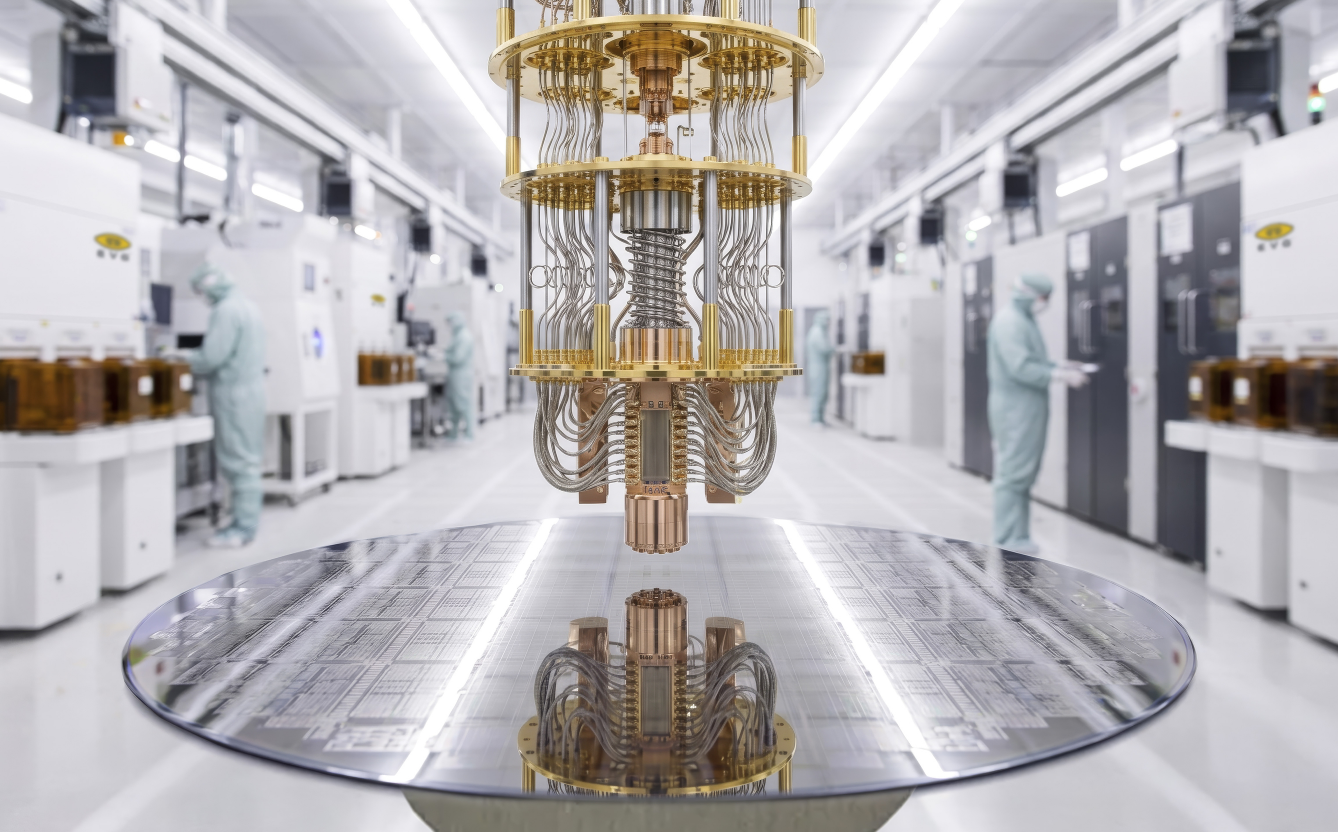
EV Group (EVG) is strengthening its role in the development of next-generation quantum computing by applying its semiconductor manufacturing expertise to help developers overcome the technical challenges of producing increasingly complex quantum chips.
The company, which specialises in advanced process solutions for semiconductor manufacturing and chip integration, is supporting quantum technology developers as they work towards scaling their systems. Its expertise in advanced packaging, heterogeneous integration and photonics manufacturing is helping customers explore new product designs and validate manufacturing processes for emerging quantum architectures.
The announcement comes as the quantum computing industry moves beyond early research demonstrations towards developing more capable systems, with manufacturers facing growing pressure to increase the number of qubits while maintaining performance and reliability.
Tackling the Manufacturing Challenges of Quantum Computing
Qubits are the fundamental units of quantum information, and increasing their numbers is an important step towards developing more powerful quantum computers. However, maintaining their performance as systems become larger presents significant engineering challenges.
Different quantum computing approaches rely on varying materials and device structures, requiring increasingly sophisticated manufacturing processes. High-density interconnections, precise wafer alignment and the integration of different materials are among the challenges facing developers.
EVG is addressing these requirements through a portfolio of technologies that includes fusion and hybrid bonding, high-vacuum oxide-free bonding, digital and nanoimprint lithography, and thin-wafer processing. These processes support the precision and integration needed to develop more complex quantum chip designs.
Supporting Different Quantum Technologies
Quantum computing encompasses several approaches, including superconducting, photonic, spin, trapped-ion, neutral-atom and nitrogen-vacancy diamond technologies. Each presents its own manufacturing requirements.
EVG’s processes are designed to support a range of these architectures. Its bonding technologies can help integrate different materials and components, while specialist lithography and wafer processing techniques support the development of advanced chip structures.
The company also works with customers through its Heterogeneous Integration Competence Center and NILPhotonics Competence Center, providing opportunities to develop and validate new manufacturing approaches.
Collaborations Supporting Future Development
EVG’s work in quantum computing includes a collaboration with Xanadu, a developer of photonic quantum computing technology, alongside its involvement with Silicon Austria Labs in the CHAMP-ION pilot line project.
CHAMP-ION aims to support industrial-scale production of ion-trap quantum chips through an open-access European pilot line. The initiative reflects the importance of collaboration between technology companies and research organisations as the industry works towards more scalable manufacturing methods.
Dr Bernd Dielacher, Director of Business Development at EVG, highlighted that different quantum computing technologies require individual manufacturing approaches. He explained that the challenge is not simply increasing qubit numbers, but integrating increasingly complex chip architectures without compromising performance.
Building the Foundations for Scalable Quantum Computing
As quantum computing continues to develop, manufacturing capabilities will play an increasingly important role in moving the technology towards practical applications.
EVG’s contribution demonstrates how established semiconductor processes can support emerging technologies, helping developers address complex integration requirements and explore new approaches to chip production.
With its continued collaborations and investment in advanced process solutions, the company is positioning its expertise at the intersection of semiconductor manufacturing and the next generation of quantum technology.
Source: The Quantum Insider,
Image: The Quantum Insider.