



For decades, global aviation has relied on a simple premise: the shortest route is the most efficient route.
That assumption has been quietly dismantled.
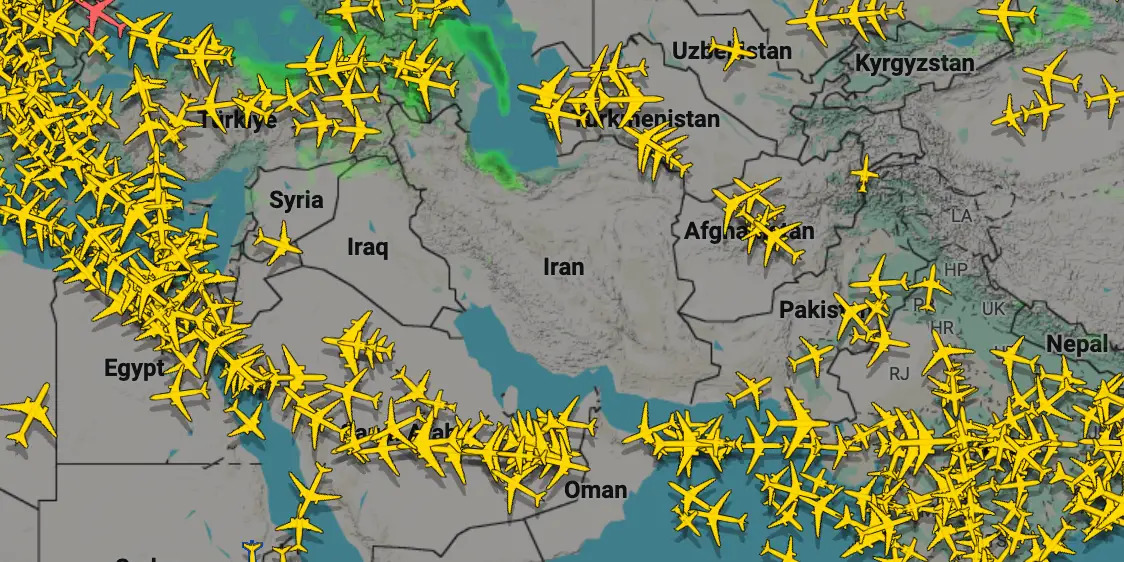
The war involving Iran has forced airlines to redraw flight paths across some of the busiest corridors in the world, particularly those linking Europe, Asia and Africa. Entire regions of airspace have effectively disappeared overnight, replaced by longer, more complex and more expensive alternatives.
What was once a tightly optimised global network has become, almost instantly, a system of detours.
The Closure of Critical Airspace
At the heart of the disruption is geography.
The Middle East is not just another region—it is a central aviation crossroads. When multiple countries across the Gulf closed their airspace, airlines lost access to key transit routes used by thousands of flights daily.
The consequences have been immediate:
- Flights diverted thousands of miles off course
- Journey times extended significantly
- Fuel consumption increased on already tight margins
In practical terms, this means that even flights not directly connected to the conflict are being affected.
A London-to-Asia route, for example, is no longer simply a straight line. It becomes a negotiation around risk, safety and cost.
Fuel Prices: The Second Shock
Rerouting alone would be manageable.
The real pressure comes from fuel.
Jet fuel prices have surged sharply since the conflict began, with some regions experiencing near doubling in costs.
Globally, the price of jet fuel has climbed toward record levels, reflecting wider spikes in oil markets triggered by the war.
For airlines, this creates a compounding effect:
- Longer routes → more fuel burned
- Higher fuel prices → higher operating costs
- Narrow margins → immediate financial strain
Fuel is already one of the largest costs in aviation. When both distance and price increase at the same time, the impact is magnified.
Disruption at Scale
The disruption is not theoretical—it is visible.
- Thousands of flights have been cancelled globally
- Major hubs in the Middle East have been partially or fully shut
- Hundreds of thousands of passengers have been stranded
At one point, more than 4,000 daily flights were cancelled, creating one of the largest disruptions to global air travel since the pandemic era.
For airlines, this is not just a logistical problem. It is a revenue shock.
For passengers, it is uncertainty—missed connections, longer journeys, and rising ticket prices.
The Economics of Delay
What makes aviation particularly vulnerable is how finely tuned it is.
Airlines operate on:
- Tight schedules
- High aircraft utilisation
- Precise fuel planning
Disruption in one part of the network cascades across the entire system.
Longer routes mean:
- Fewer flights per aircraft per day
- Increased crew costs
- Higher maintenance strain
At the same time, ticket prices are rising as airlines begin to pass on costs. Industry leaders have already warned that sustained conflict will inevitably lead to more expensive air travel.
Cargo and Trade Feel the Impact
The effect extends beyond passengers.
Air freight rates have surged—by as much as 70% on some routes—as cargo planes face the same detours and fuel pressures.
This matters because aviation is not just about travel. It underpins:
- Global supply chains
- High-value goods transport
- Time-sensitive logistics
When aviation slows, trade slows with it.
A Fragile System Under Pressure
The deeper insight from the RTE analysis is not simply that aviation is disrupted—it is how exposed it is to geopolitical shocks.
The industry depends on:
- Stable airspace
- Predictable fuel costs
- Open global corridors
The Iran conflict has challenged all three simultaneously.
Even if airspace reopens quickly, the after-effects may linger:
- Elevated fuel prices
- Rerouted infrastructure habits
- Higher insurance and risk costs
The Outlook
The aviation industry has always been resilient. It adapts quickly, recalibrates routes, and absorbs shocks where it can.
But this moment is different in its combination of pressures.
Airspace disruption, fuel volatility and geopolitical risk are converging at the same time—turning what might have been a regional conflict into a global aviation issue.
If the conflict continues, the implications are clear:
- Longer journeys
- Higher fares
- A more cautious, less efficient global network
What we are seeing is not just disruption.
It is a reminder that aviation’s greatest strength—its global interconnectedness—is also its greatest vulnerability.