



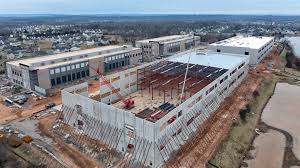
Construction has long been one of the world’s most complex and least digitised industries.
Projects run on fragmented data, shifting timelines and supply chains that depend as much on relationships as they do on systems. Delays are common. Cost overruns are expected. Coordination remains the defining challenge.
That is precisely the inefficiency a new generation of startups is targeting.
At the centre of that movement is Krane, a San Francisco-based company building AI agents designed not just to analyse construction data, but to act on it.
From Spreadsheets to Autonomous Execution
Krane’s proposition is simple in concept, but significant in implication.
Its platform aggregates construction data, pulling inputs from spreadsheets, project schedules and supplier communications into a single system. It then deploys specialised AI agents to manage procurement workflows, track orders, communicate with vendors and reconcile invoices.
This is not traditional construction software.
It is a shift from passive systems to active ones.
Instead of providing visibility into delays or cost pressures, Krane’s agents are designed to intervene directly, comparing supplier quotes, analysing lead times and selecting optimal procurement pathways based on real-time project conditions.
In effect, it turns supply chain management from a coordination exercise into an automated process.
Why Data Centres Are the Starting Point
Krane’s early focus on data centre construction is deliberate.
These projects represent some of the most complex builds in the global economy, requiring precise coordination of specialised equipment, from generators and cooling systems to electrical infrastructure. Even minor delays in critical components can cascade into significant cost overruns.
As demand for AI infrastructure accelerates, driven by hyperscale cloud providers and enterprise adoption, the volume and urgency of data centre construction has increased dramatically.
That creates a perfect environment for automation.
Krane’s platform is already being used across sectors including healthcare and education, but data centres, where timelines are tight and margins are sensitive to delay, highlight the value proposition most clearly.
The Rise of Agentic AI in Construction

What distinguishes Krane from earlier construction tech is its use of agentic AI.
Rather than building a single system, the company deploys multiple specialised agents, each responsible for a different aspect of the supply chain. Some track deliveries. Others flag supply risks. Voice-enabled agents can even handle vendor communication autonomously.
This reflects a broader trend across the sector.
Startups such as Trunk Tools and Scalera are also developing AI agents capable of automating workflows ranging from scheduling to procurement.
The underlying shift is consistent.
Construction software is moving from tools that support decisions to systems that execute them.
A $9 Million Signal
Krane’s recent $9 million seed round, backed by Glasswing Ventures and Link Ventures, is modest by Silicon Valley standards. But its significance lies elsewhere.
It signals growing investor confidence in the application of AI within construction, a sector historically resistant to digital transformation.
More notably, the company’s approach reflects a broader shift in startup economics.
Its founder has emphasised building lean teams powered by AI, rather than scaling large engineering organisations. The implication is clear: AI is not just the product, it is the operating model.
Solving a Structural Problem
The problem Krane is addressing is not new.
Construction projects have long been constrained by fragmented procurement processes, manual coordination and limited visibility across supply chains. These inefficiencies translate directly into cost overruns and missed deadlines.
What is new is the ability to solve them at scale.
By integrating with existing platforms such as Autodesk and Procore, Krane does not replace current systems. It overlays them, orchestrating workflows across tools that were never designed to operate as a unified whole.
This approach is critical.
Transformation in construction rarely comes from replacement. It comes from integration.
The Strategic Implication
Krane’s emergence points to something larger than a single startup.
It reflects a structural shift in how complex industries are beginning to operate.
For decades, construction has lagged behind sectors such as finance and manufacturing in digital adoption. That gap is now closing rapidly, driven not by incremental software improvements, but by AI systems capable of coordinating entire workflows.
For developers, contractors and infrastructure investors, the implications are immediate:
- Reduced delays and tighter project timelines
- Greater control over procurement and cost management
- Improved resilience across supply chains
In sectors like data centres, where time-to-completion directly impacts revenue generation, these gains are not marginal. They are strategic.
A New Operating Model for Construction
The construction industry is not being disrupted overnight.
But it is being reconfigured.
Krane and its peers are introducing a model where coordination is no longer manual, where procurement is no longer reactive, and where supply chains are no longer opaque.
Instead, they are becoming systems that think, act and adapt in real time.
For an industry built on physical infrastructure, that shift towards digital intelligence may prove to be one of its most important transformations yet.