




In a bold stride toward industrial sustainability, Lloyds Metals and Energy Ltd (LMEL) is transforming its Surjagarh Iron Ore Mine in Maharashtra’s Gadchiroli district into what is set to be India’s first certified “green mine.” With a technology-first approach to decarbonisation, logistics, and resource optimisation, the company is establishing a new benchmark for sustainable mining in the country.

Decarbonising Mining Operations
Surjagarh has already reduced carbon emissions by an estimated 32,000 tonnes annually, with future integration of renewable energy expected to push that figure to over 50,000 tonnes. LMEL’s Managing Director, B. Prabhakaran, emphasised the company’s broader vision:
“Our core philosophy revolves around adopting green technologies, improving efficiency, fostering innovation, and engaging both employees and the local community, all in pursuit of ‘green steel’ production. This aligns perfectly with India’s ‘Net Zero’ commitment.”
Electrification and Smart Logistics
Among its major innovations is the deployment of electric compressor-mounted drills—the first of their kind globally. LMEL is also phasing out diesel-run heavy earthmoving equipment, replacing them with electric alternatives. Battery-powered loaders and trucks are already in operation at the site.
To further reduce its carbon footprint, LMEL has constructed an 87-kilometre-long iron ore slurry pipeline. This eliminates the need for truck-based ore transport, significantly reducing emissions and road congestion. Additionally, the mine has introduced LNG-powered vehicles to diversify its clean transport solutions.
Environmental Stewardship
The company has launched an expansive afforestation initiative, having planted over 300,000 trees across nearly 400 hectares. It has also rejuvenated water bodies and established infrastructure to recycle up to 85% of wastewater used in mining operations.
These efforts fall under LMEL’s “Mission Green,” a long-term plan to embed environmental consciousness at every level of the mining process—from exploration and extraction to processing and transport.
National Recognition and Regulatory Green Light
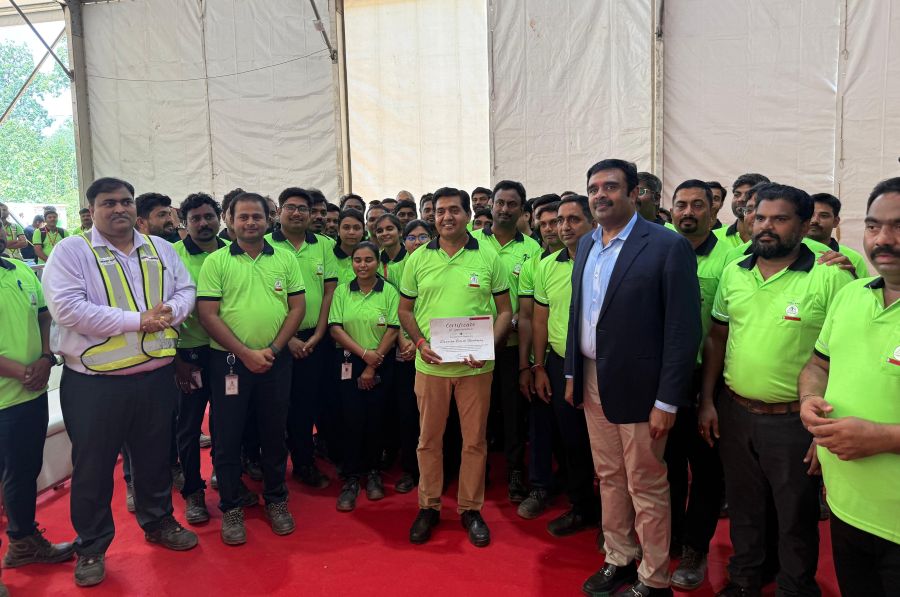
In July 2025, the Indian Bureau of Mines (IBM) awarded Surjagarh a five-star rating under its Sustainable Development Framework. The certification was granted for exceeding 90% across key environmental and social criteria, including air and water management, biodiversity protection, and technological innovation.
The mine also recently received environmental clearance from the Expert Appraisal Committee (EAC) to scale production from 10 million to 26 million tonnes per annum. The expansion will include the processing of 45 million tonnes of Banded Hematite Quartzite (BHQ), which will be transported exclusively via slurry pipeline. The approval also mandates a clean vehicle quota and enhanced biodiversity monitoring.
A New Model for Industrial Tech
Surjagarh’s transformation holds strong implications for technology and sustainability professionals:
- Electrification of mining equipment mirrors trends in autonomous vehicle development and industrial IoT.
- Slurry pipeline systems function as high-efficiency, low-impact transport infrastructures—comparable to data pipelines in cloud architecture.
- Circular economy principles are applied to BHQ, a previously discarded byproduct, now repurposed as a valuable resource.
- Remote monitoring and automation are integrated across drilling, beneficiation, and logistics, offering a scalable blueprint for other extractive industries.
The Road Ahead
With long-term plans to expand production to 55 million tonnes per annum and integrate advanced beneficiation and pelletisation facilities, LMEL’s approach blends heavy industry with cutting-edge sustainability. The Surjagarh site is emerging not only as India’s largest iron ore mine but also as a technological proving ground for the future of green mining.