


Europe’s downstream industry is entering another period of adjustment. Refiners, petrochemical producers, EPC contractors, licensors and technology companies are all working against the same backdrop: shifting demand, rising pressure to decarbonise, tighter requirements around efficiency and competitiveness and a growing need to make investment decisions with greater precision. These pressures are no longer abstract. They are influencing project pipelines, asset strategies and partnership models across the sector.
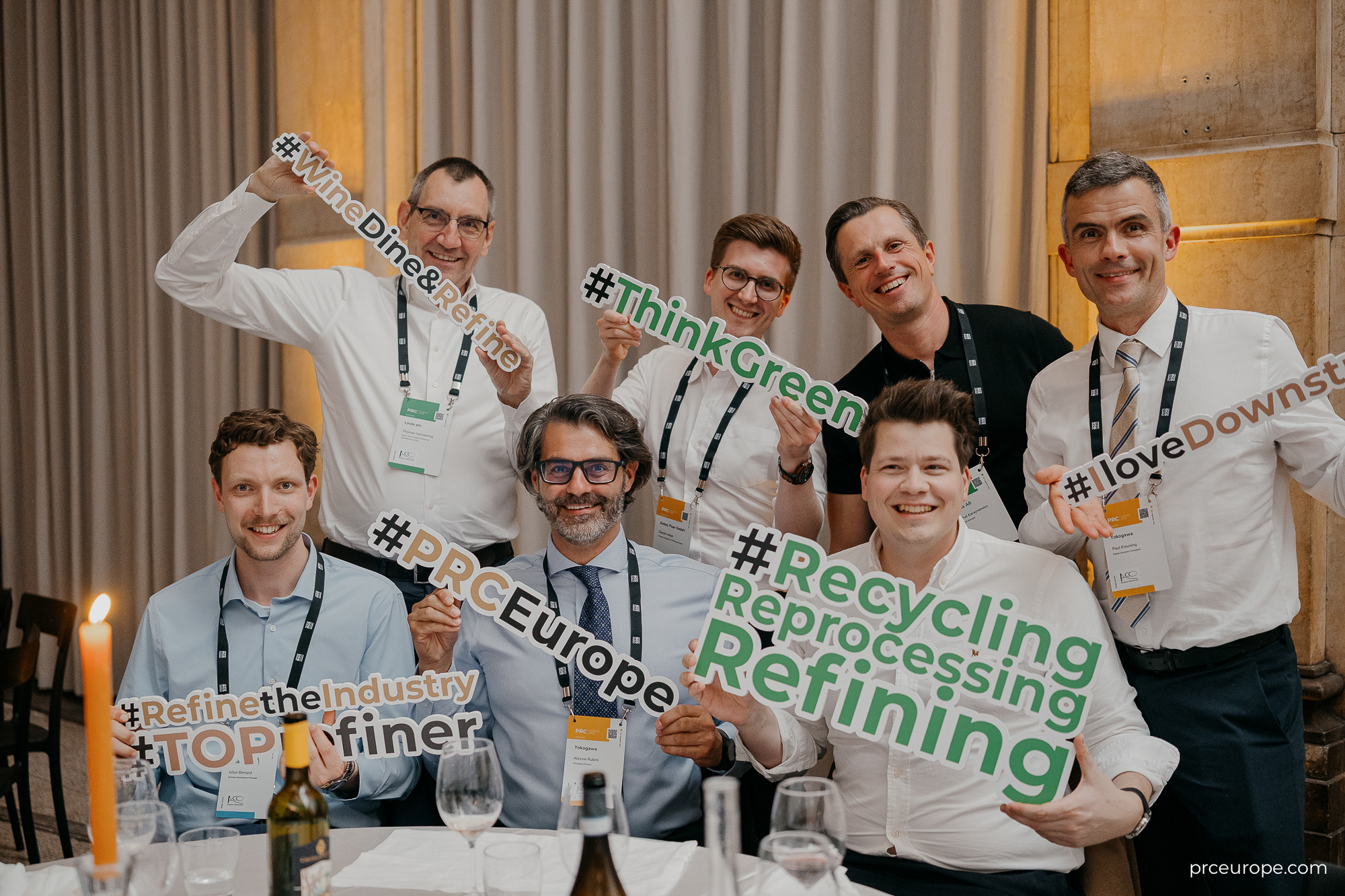
This is the setting in which the Petrochemical and Refining Congress (PRC): Europe 2026 returns to Amsterdam on 18-19 May for its 10th anniversary edition. PRC Europe is not simply another industry event. It is built as a business platform for downstream professionals – a place where commercial dialogue, technical thinking and project-level discussion come together in one room.
A format designed for better conversations
One of the defining features of PRC Europe is its closed-door format – this is not an open exhibition where traffic is mixed and attendance can be incidental. The audience is curated and the participants are there with a purpose to meet relevant counterparts, discuss live projects, test ideas and move conversations forward.
“At PRC, there are many operating companies and a lot of other companies that are of our interest. We can make good contacts with our clients and also with people that we work with. The organisation is very good, making sure that you can meet people that you want to meet, and all the presentations are very good as well”, – Mathijs van Es, Senior Director Business Development at Lummus Technology LLC.
The business programme is built around speakers who are directly involved in the projects, technologies and decisions shaping the sector. This year’s Congress is hosted by Fluor and supported by Regional Partners: Lummus Technology, Sonatrach Raffineria Italiana, Wood and Repsol, together with Technology Partner – KBR, all of which are going to contribute to the programme.
Lummus Technology: the business case behind cleaner technologies
From Lummus Technology, Jose de Barros, Chief Decarbonization Officer, is going to present on sustainability and profit pathways in the energy transition era.
The speaker’s topic addresses a question many companies are now asking: which technologies can support decarbonisation without undermining commercial logic? This presentation looks at biofuels and SAF production, hydrogen generation through Advanced Ionics’ low-temperature electrolysis, low-emissions hydrogen based on industrial waste heat, chemical recycling and PFAS treatment.
What makes the topic especially relevant is its framing. This is not innovation for its own sake. It is a discussion about where technology can create both environmental value and business value, and where the two can realistically reinforce each other.
Sonatrach Raffineria Italiana: what decarbonisation means at refinery level
For European refineries, decarbonisation is no longer a distant framework. It is already tied to operating reality, regulation, product mix and long-term viability. This is the perspective Rosario Pistorio, Managing Director at Sonatrach Raffineria Italiana S.r.l., is bringing in his speech on the challenge of decarbonisation for a European refinery.
Rather than approaching the topic at a purely strategic level, the presentation moves directly into the realities of refinery business. It looks at the impact of ETS, RED III, SAF requirements and Italy’s wider energy and climate planning, while focusing on two practical challenges in particular: reducing the carbon footprint of fossil-based fuels and introducing alternative fuels based on non-fossil raw materials.
The value of this topic lies in its operational focus – it connects policy, operations and long-term planning in a way that is highly relevant for companies trying to remain competitive while adapting to a rapidly changing environment.
Repsol: decarbonisation seen from the end-user side
Eduardo de la Rocha Camba, Primary Conversion Scientist at Repsol, is going to share end-user perspectives on industrial decarbonisation and energy efficiency and talk about the StreamSTEP Horizon Europe Project.
This contribution stands out because it brings an end-user perspective to an issue often discussed in abstract terms. The topic focuses on industrial decarbonisation in relation to Scope 1 and 2 emissions, with particular emphasis on thermal demand, waste heat recovery and high-temperature heat pumps in refinery and petrochemical operations.
The presentation is expected to show how these technologies move from technical potential to measurable impact. In a business environment where energy efficiency is once again being treated as a strategic priority, rather than a side initiative, that perspective is likely to resonate widely.
Wood: why waste heat is drawing more attention
Waste heat is not always the headline topic in discussions about downstream transformation, but it is steadily moving up the agenda. The reason is straightforward: it sits close to operational performance, emissions reduction and cost discipline at the same time. That combination makes it especially attractive to operators looking for realistic, near-to-medium-term improvements.
Mark Cudmore, Executive Consultant at Wood, is going to speak on the downstream industry activity in emerging waste heat technologies. Wood’s contribution is therefore likely to add useful perspective to a part of the transition that is becoming harder to ignore.
KBR: taking a closer look at SAF pathways
SAF continues to attract significant attention across the sector, but interest alone does not move projects forward. The more difficult questions begin at the early development stage: which pathways are practical, how capital-intensive they are, what risks emerge before execution, and how scalable they really look once the engineering work begins.
These questions sit at the centre of the presentation on early-stage project experience to assess approved SAF production pathways from Dhirender Malik, Principal Consultant at KBR. Many companies are now moving from general interest in SAF to a closer evaluation of what specific pathways require in practice. This makes KBR’s perspective especially relevant for businesses trying to understand where the differences between approved pathways begin to matter commercially and operationally.
A programme shaped by real business questions
Taken together, these topics reflect that PRC Europe is built not around generic commentary, but around the questions companies are already working through: profitable transition pathways, refinery resilience, energy efficiency, low-carbon fuels and the role of technology in maintaining long-term competitiveness.
Just as importantly, those topics are not treated in isolation. They are discussed in a setting where operators, technology providers, engineering companies and strategic decision-makers can speak directly with one another. Often that is where the real value appears – not only in what is said on stage, but in the conversations that follow.
“This congress is very special because it covers both petrochemical and refining sectors that sometimes are connected, so it’s important to cover both of these subjects. And also this is the occasion to meet a lot of other companies like us, but also vendors, or specialists, or licensors and so on. So we can speak more broadly about everything and discover if there are new things coming up”, – Raffaella Lucarno, Head of Biorefining & Supply at Enilive SpA.
For businesses active in refining, petrochemicals, industrial technology, engineering or services, PRC Europe 2026 offers more than visibility. It offers context, contact and a setting in which useful partnerships can begin: join the conversation.Website: https://sh.bgs.group/40o