



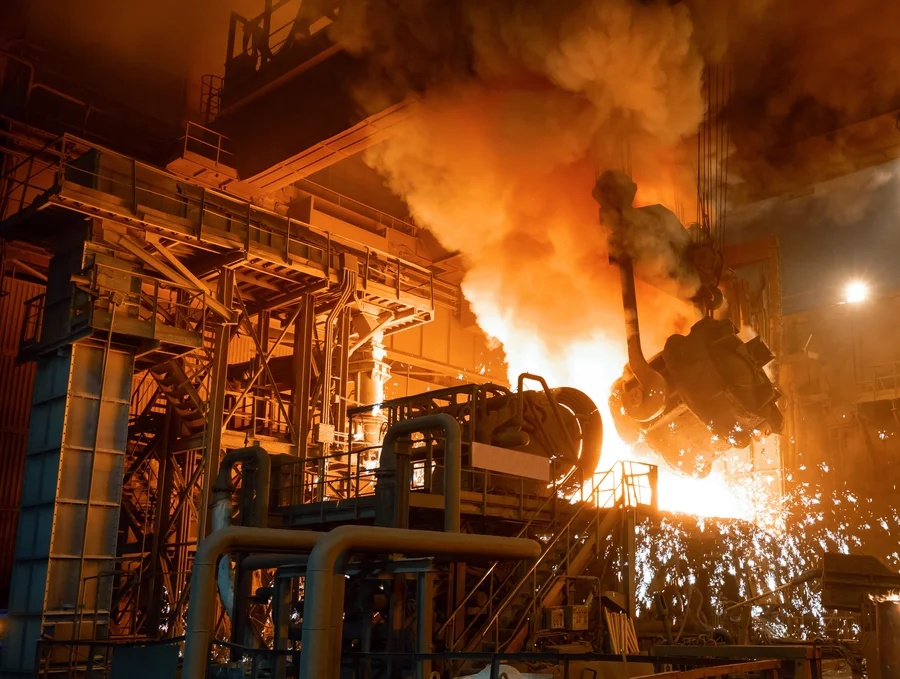
Heavy industry sits at the centre of the global decarbonisation challenge. Sectors such as steel, cement and petrochemicals remain essential to economic growth, yet they are also among the world’s most carbon-intensive industries.
A growing body of research now points to carbon capture and storage (CCS) as one of the technologies capable of bridging that gap. According to new analysis highlighted by Standard Chartered, scaling CCS infrastructure could significantly accelerate the decarbonisation of industrial supply chains, including the steel sector.
The bank’s latest transition-finance insights suggest that strong regulation, cross-border collaboration and large-scale investment will be critical to unlocking the potential of carbon capture across Asia and other emerging industrial hubs.
Why Carbon Capture Matters for Clean Steel
Steel production remains one of the most carbon-intensive industrial processes in the world. Traditional blast-furnace methods rely heavily on coal, producing vast quantities of carbon dioxide.
Industry data indicates that steel manufacturing accounts for roughly 7–8% of global CO₂ emissions, making it the single largest industrial source of emissions worldwide.
At the same time, steel is foundational to modern economies. It is used in:
- construction and infrastructure
- automotive manufacturing
- renewable energy systems
- transport and logistics
Completely eliminating steel production emissions overnight is not realistic. This is why technologies such as carbon capture are gaining traction.
CCS systems capture carbon dioxide at the point of emission and store it permanently underground or repurpose it in other industrial processes. In sectors where electrification or alternative fuels remain years away from viability, CCS provides a pathway to continue operating while reducing emissions.
Carbon Capture Could Deliver a Third of Global Emissions Cuts
Energy analysts increasingly see carbon capture as a cornerstone of global climate strategies.
Research from energy consultancy Wood Mackenzie suggests that carbon capture technologies could contribute up to one-third of the emissions reductions needed to reach global net-zero targets by 2050.
The reason is simple: many industrial processes produce emissions that cannot easily be eliminated through renewable energy alone.
Industries such as steel, cement and petrochemicals generate carbon dioxide as a by-product of chemical reactions, not just fuel combustion. Capturing those emissions at source therefore becomes one of the few viable decarbonisation pathways.
Asia: The Frontline of Industrial Decarbonisation
Asia plays a decisive role in the global emissions landscape. Rapid economic growth, expanding infrastructure and large manufacturing bases mean the region hosts some of the world’s highest industrial emissions.
Countries such as China, India and Indonesia generate significant emissions from heavy industry and power generation.
At the same time, many Asian economies still rely heavily on carbon-intensive sectors for growth and employment. This creates a complex challenge: balancing economic development with climate commitments.
For this reason, CCS is increasingly viewed as a practical transition tool.
In markets where renewable energy cannot yet fully replace fossil fuels, capturing emissions directly from industrial facilities could enable industries to continue operating while progressively lowering their carbon footprint.
Cross-Border Collaboration Is Key
Building carbon capture infrastructure is a major undertaking. It requires pipelines, storage sites, regulatory frameworks and long-term financing.
Many countries may have industrial emitters but lack suitable geological storage sites for captured carbon dioxide. This is why cross-border CCS infrastructure is emerging as a key solution.
A notable example is the S-Hub initiative in Singapore, which aims to capture and permanently store around 2.5 million tonnes of CO₂ annually by 2030 through regional partnerships.
The project involves collaboration with neighbouring markets including Indonesia, Malaysia and Japan, highlighting the increasingly regional nature of industrial decarbonisation.
Shared infrastructure allows countries to:
- pool investment costs
- aggregate emissions from multiple industries
- utilise storage sites across borders
- accelerate deployment of CCS technology
The Barriers to Scaling CCS
Despite its promise, carbon capture remains in the early stages of large-scale deployment. Several challenges continue to slow progress.
According to Standard Chartered’s analysis, the main obstacles include:
- Unclear regulatory frameworks in some markets
- Lack of cross-border alignment on carbon transport and storage rules
- Supply-chain readiness for large-scale CCS infrastructure
While several Asian countries have begun implementing policies to support CCS, the regulatory landscape is still evolving.
For example, Indonesia has introduced multiple CCS regulations since 2023, while Malaysia recently passed a dedicated Carbon Capture, Utilisation and Storage bill. However, detailed commercial structures and implementation mechanisms are still being developed.
Without consistent policies and financing models, scaling CCS across industries could remain slow.
The Role of Transition Finance
Large-scale CCS infrastructure will require billions of dollars in investment. This is where financial institutions and transition-finance frameworks come into play.
Banks and investors are increasingly positioning themselves as enablers of industrial decarbonisation, helping fund projects that reduce emissions while maintaining economic activity.
Standard Chartered, for example, has committed to mobilising hundreds of billions of dollars in green and transition finance by 2030 as part of its broader net-zero strategy.
Transition finance is particularly important for sectors such as steel, where decarbonisation requires entirely new industrial infrastructure.
By supporting CCS deployment, financial institutions could help bridge the gap between climate ambition and industrial reality.
A Strategic Opportunity for Industrial Transformation
Although still emerging, carbon capture technology is increasingly viewed as a strategic opportunity for regions seeking to decarbonise without sacrificing industrial competitiveness.
As Yingying Chen, Director of Transition Finance at Standard Chartered, noted in the report, CCS could help accelerate sustainable growth while fostering collaboration across markets and industries.
For sectors like steel, the stakes are particularly high. Global demand for steel is expected to remain strong as economies expand and infrastructure investment continues.
The challenge is ensuring that growth does not come at the expense of climate progress.
Scaling carbon capture may not be the entire solution, but it is rapidly becoming one of the most important tools available for transforming heavy industry.