



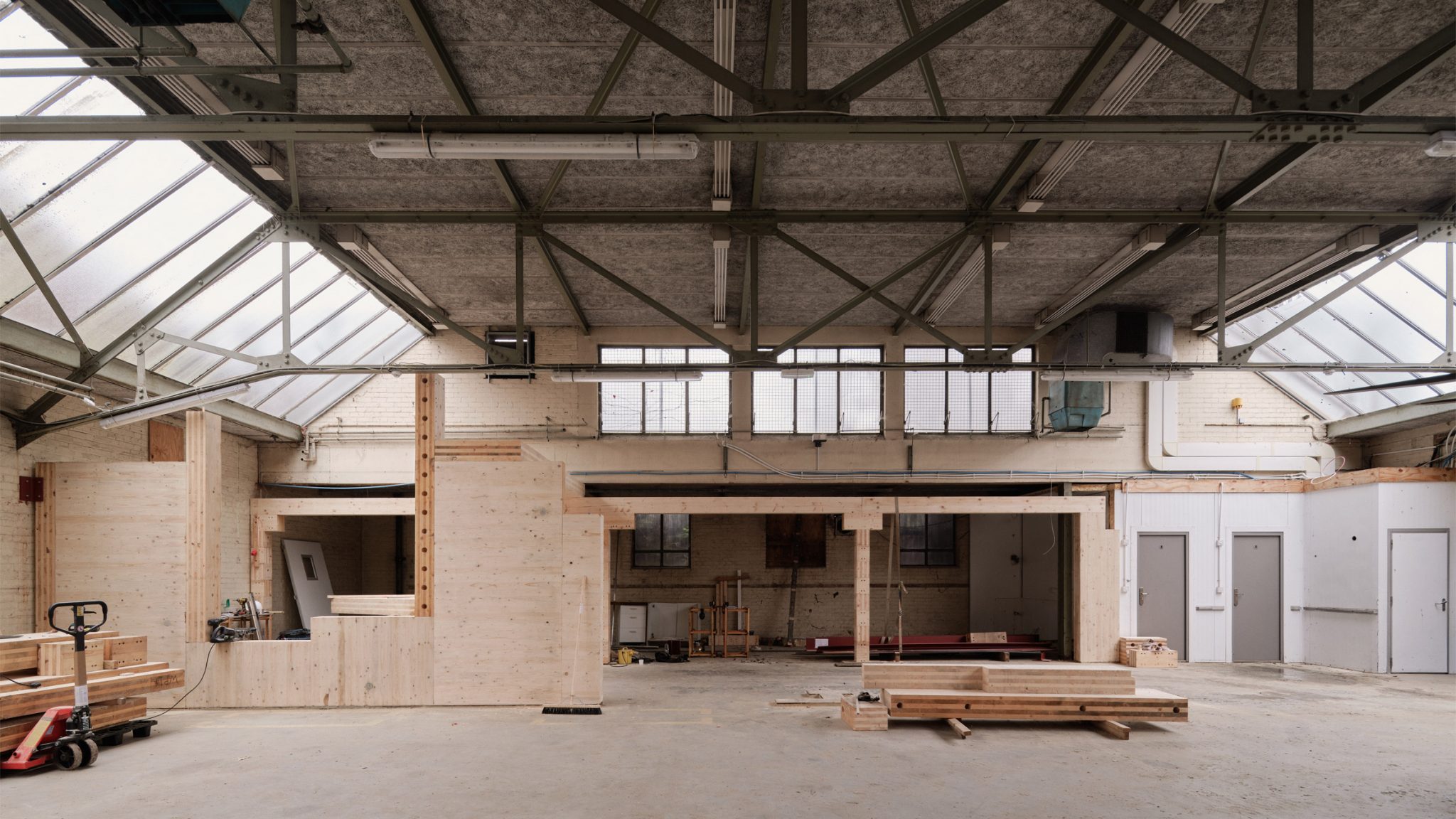
From Construction Waste to Circular Infrastructure
In East London’s Royal Docks, a project has emerged that feels less like a building and more like a prototype for an entirely different construction system.
Tipping Point East is being positioned as the UK’s first circular construction hub—a place where materials are not discarded but continuously reused, processed and redeployed into new developments.
At its core is a simple but radical idea: construction should no longer be linear.
No more extract, build, demolish, waste.
Instead, the industry must learn to operate like an ecosystem.
A New Type of Infrastructure
Unlike traditional construction sites, Tipping Point East is not defined by a single output. It is an operational hub—part warehouse, part workshop, part educational space—designed to intercept materials before they become waste.
Spread across a large industrial site, the hub:
- Stores reclaimed construction materials
- Processes and adapts them for reuse
- Redistributes them into new building projects across London
It effectively inserts a missing layer into the construction supply chain—one that has historically been absent.
Because until now, there has been no infrastructure for reuse at scale.
The Scale of the Problem It Addresses
The urgency behind the project becomes clearer when viewed against the numbers.
Construction is responsible for:
- Around 62% of the UK’s total waste output
- Over 100 million tonnes of waste annually from construction, demolition and excavation
Even with high recycling rates, millions of tonnes still end up in landfill each year.
What Tipping Point East proposes is not marginal improvement—but systemic intervention.
By capturing materials upstream, before disposal, it reduces:
- Embodied carbon in new buildings
- Demand for virgin resources
- Pressure on landfill and ecosystems
In practical terms, the hub is expected to divert hundreds of tonnes of material from landfill in its early years alone.
Designed as a System, Not a Building
What makes the project distinctive is not just what it does, but how it is conceived.
Tipping Point East is being developed by a collaboration between:
- Yes Make
- RESOLVE Collective
- Material Cultures
Supported by the Mayor of London and the London Borough of Newham, it forms part of a wider ambition to create a Circular Economy Village over the coming years.
The intention is not simply to build differently—but to train, educate and scale a new way of building.
That includes:
- Skills programmes in circular construction
- Community engagement and cultural activity
- Practical demonstrations of low-carbon building techniques
It is infrastructure, but also pedagogy.
London as a Test Bed for Circular Construction
The location is not incidental.
The Royal Docks is one of London’s largest regeneration zones, with tens of thousands of homes and jobs planned over the coming years.
This creates a rare alignment:
- High construction demand
- Available industrial land
- Political backing for sustainability
In effect, the area becomes a live testing ground for circular construction at scale.
Rather than retrofitting sustainability into existing systems, Tipping Point East embeds it directly into one of the capital’s most active development pipelines.
From Linear Industry to Circular Economy
The deeper significance of the project lies in what it suggests about the future of construction itself.
For decades, the industry has operated on a linear model:
- Extract raw materials
- Manufacture components
- Build structures
- Demolish and discard
Circular construction reverses that logic:
- Materials remain assets, not waste
- Buildings become temporary assemblies
- Supply chains extend beyond first use
Tipping Point East is one of the first serious attempts to operationalise that model at city scale.
The Outlook
Tipping Point East will not, on its own, transform the construction industry.
But it does something arguably more important.
It proves that a different system is possible—and begins to build the infrastructure required to support it.
If successful, the implications extend far beyond London:
- Reduced carbon emissions across the built environment
- New industries centred on reuse and refurbishment
- A redefinition of what “materials” mean in construction
The project’s name is deliberate.
Not because the transition has already happened—but because it suggests where the tipping point might begin.