




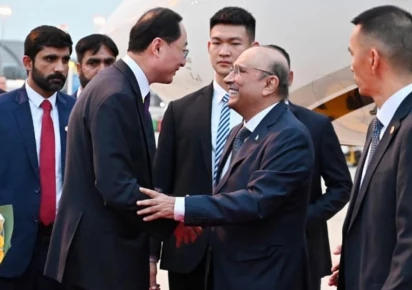
Landing in Chengdu, President Zardari was greeted by senior Chinese officials, bouquets, and ceremony. The real highlight? His tour of AVIC—the hugely influential Aviation Industry Corporation of China, a powerhouse in both civilian and military aircraft manufacturing. It’s an operation few foreign heads of state have seen up close.
At AVIC, Zardari got a behind-the-glass look at the production lines. Fighter jets in motion. Engineers briefing him on co-produced aircraft like the J-F-17 Thunder. The newer J-10C fighters played a starring role—machines whose reputation has grown in recent months, and whose presence in AVIC’s hangars signals serious capability.
Signals Beyond the Hangar
It wasn’t just optics. The visit sent signals of deeper alignment:
- Zardari praised how aircraft like the J-10 and JF-17 have become more than hardware—symbols of Pakistan’s aerial strength, particularly in recent operations.
- He was briefed on advanced tech—stealth designs, unmanned vehicles, command and control systems. These aren’t just future concepts; they’re being rolled out, refined, and produced.
- Travel between Chengdu and Mianyang by high-speed rail introduced him to China’s infrastructure in motion: speed, safety, and scale. It was more than travel—it was demonstration.
What This Means Moving Forward
For Pakistan, this relationship stakes out more than aircraft or trade. It’s about:
- Repairing, bolstering, and co-owning defence production—so that more of the aircraft, systems, and knowledge stay domestic.
- Upgrading technology pipelines. As others push forward in drone warfare, jet design, and automated systems, Pakistan’s interest in staying competitive is clear.
- Deepening diplomatic support: China, in turn, is showing investment not just in factories, but in partnership, joint capabilities, and shared strategic interests.
Voices from the Visit
Zardari himself reflected on what he saw:
“The J-10 and JF-17 have greatly strengthened the Pakistan Air Force…” he said, pointing to recent operations and regional challenges as tests of that strength.
He also hailed AVIC as “a symbol of China’s technological advancement and of the enduring strategic partnership between Pakistan and China”—underline on “enduring.”
Bottom Line
Diplomacy is often measured in words—but this time, it’s also in steel, in engine hum, in production halls. What President Zardari saw in China wasn’t just show—it was machinery, might, and mutual ambition. If this visit leads to deeper cooperation—as the signs suggest—it could reshape Pakistan’s future in aviation and defence, not just in its hangars, but in its skies.