



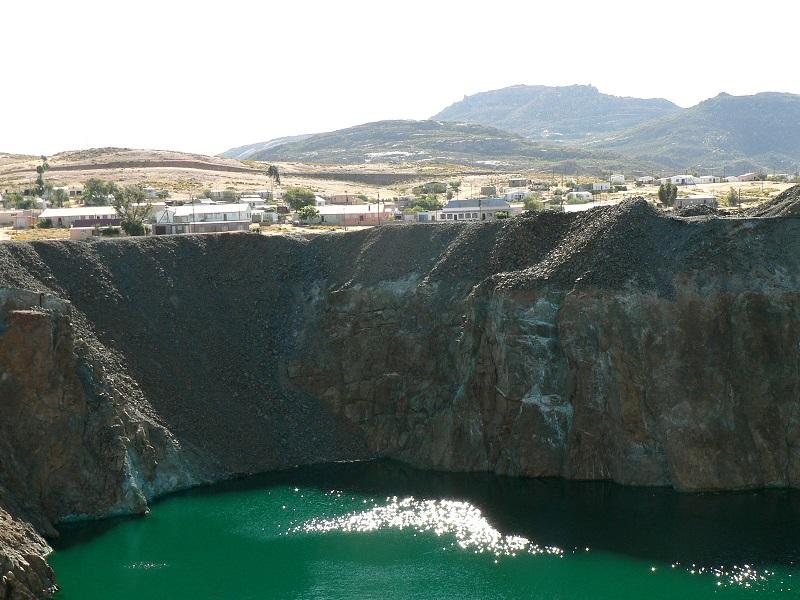
There are few places where history and future demand intersect as clearly as Okiep. Once regarded as the richest copper mining site in the world, this small Northern Cape town now finds itself at the centre of a renewed push to revive copper production, driven not by nostalgia, but by global necessity. What was once South Africa’s first major commercial mining hub is being reconsidered as part of a much larger shift in how the world sources the materials required for electrification and energy transition.
The story of Okiep stretches back centuries. Indigenous Nama communities were among the first to identify copper in the region, long before European settlers arrived. By the late 17th century, Dutch colonial authorities had begun exploring the deposits, and by the mid-1800s, mining activity accelerated rapidly. The discovery triggered a wave of prospectors and investment, transforming the area into the backbone of the Cape Copper Company’s operations.
What followed was a familiar cycle in mining. Growth, decline, and eventual dormancy as market conditions shifted and logistical challenges mounted. Despite its geological richness, Okiep’s remote location limited its long-term viability in earlier industrial phases. For much of the 20th century, its significance faded as global mining centres shifted elsewhere.
What makes the current moment different is not the geology, but the context.
Copper has re-emerged as one of the most strategically important materials in the global economy. Its role as a highly efficient electrical conductor places it at the centre of modern infrastructure, from power grids and telecommunications to electric vehicles and renewable energy systems. Demand is rising not incrementally, but structurally, as economies electrify and decarbonise at scale.
This is what reframes Okiep. The same deposits that once powered early industrial expansion are now being viewed through the lens of future energy systems. Plans to restore the Okiep mine complex are not simply about reopening an old site. They are about reactivating a resource that aligns directly with global demand trends.
The strategic logic is clear. Existing mining regions with proven reserves offer a faster route to production than entirely new discoveries. Infrastructure, even if aged, provides a foundation. Historical knowledge of the ore body reduces uncertainty. In a market where supply constraints are becoming more visible, these advantages matter.

Yet revival is not straightforward. Restarting a historic mining complex involves more than extracting ore. It requires rebuilding infrastructure, securing investment, navigating regulatory frameworks and re-establishing a workforce in a region that has seen decades of decline. The economics of modern mining are also different. Efficiency, sustainability and global pricing pressures all shape viability in ways that did not apply in earlier eras.
What sits beneath the optimism is a broader trend across the mining sector. Legacy assets are being reassessed, not just for what they produced, but for what they could produce in a new economic environment. As demand for critical minerals accelerates, previously marginal or dormant sites are being drawn back into consideration.
Okiep fits squarely into that narrative.
Its history gives it credibility. Its geology gives it relevance. And the global energy transition gives it timing.
What remains uncertain is execution. Revival depends on aligning investment, infrastructure and market conditions in a way that sustains long-term production rather than short-term extraction. That is where many mining projects succeed or fail.
The deeper story, however, is less about one town and more about what it represents.
Okiep is not unique in its past. What may make it significant again is its future.
As demand for copper continues to rise, the industry is being forced to look both forward and backward at the same time, searching for new deposits while rediscovering old ones. In that sense, Okiep’s comeback is not just a local development. It is part of a wider recalibration of where the materials powering the next phase of global growth will come from.