




A recent scientific advance in understanding hypersonic airflow may bring what once seemed science-fiction-level aviation a step closer to reality: the possibility of flights that span the globe in around one hour. Researchers at Stevens Institute of Technology have announced findings that revise how turbulence behaves in hypersonic regimes — a notoriously challenging barrier for ultra‐high-speed aircraft design.
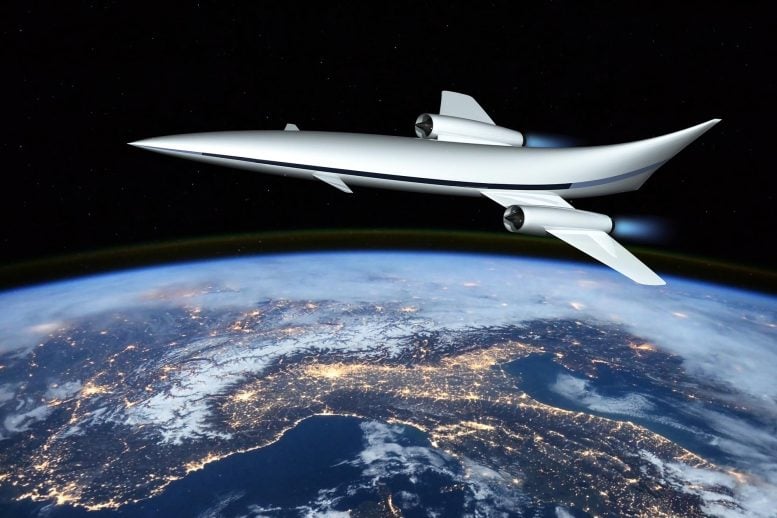
The Discovery
The study focused on turbulence at roughly Mach 6 (about six times the speed of sound). Using laser-based flow diagnostics and advanced modelling, the researchers found that certain turbulent flow features at hypersonic speeds resemble those at much lower speeds. This goes against long-standing assumptions that hypersonic turbulence would behave wildly differently, necessitating entirely new design paradigms.
In particular, by validating aspects of “Morkovin’s hypothesis” (which posits that compressible turbulent flows may mirror incompressible ones under certain conditions), the team has given designers fresh confidence that existing computational fluid dynamics (CFD) tools and techniques may remain applicable — albeit at elevated speeds.
Why This Matters for Ultra-Fast Travel
For commercial hypersonic aircraft (and even spaceplane-type vehicles) the major technical hurdles extend far beyond raw speed. Among them:
- Managing intense heat and aerodynamic load during high-speed flight.
- Designing airframes and propulsion systems that handle the extreme conditions of Mach 5+ flight.
- Accurately modelling aerodynamic behaviour so that flights are safe, efficient and predictable.
With turbulence models becoming more tractable at hypersonic speeds, the development timeline for viable ultra-fast commercial aircraft may accelerate. Consider that if an aircraft could sustain Mach 5–7 for cruise (rather than bursts), intercontinental flights that today take 12-15 hours could potentially shrink to one-to-two-hour journeys.
Potential Applications
Beyond ultra-fast passenger flights, the implications are broad:
- Global business travel: CEO’s could attend meetings on opposite sides of the world within a tangible commute timeframe.
- High-value cargo: Time-sensitive logistics (e.g., perishable goods, critical pharmaceuticals) could benefit from dramatically reduced delivery times.
- Integrated aero-space operations: Vehicles that transition between high-altitude/hypersonic flight and near-space release of payloads may become more feasible.
- Defence and rapid response: Hypersonic platforms already attract military interest for global reach, and the new insights may enhance dual-use commercial/military platforms.
Key Challenges Still Ahead
Despite the breakthrough, several major hurdles remain before one-hour flights become commercially viable:
- Propulsion systems: Sustaining flight at Mach 5+ over long distances means fuel‐efficiency, thermal management and air-intake design must be solved at scale.
- Materials: Dedication to heat-resistant materials, structural integrity at extreme speeds and fatigue from thermal cycling are still very much engineering bottlenecks.
- Regulation and safety: Certification for hypersonic passenger craft will require new frameworks, and public acceptance of ultra-fast flights remains untested.
- Cost and infrastructure: From noise/sonic-boom concerns to fuel cost and airport integration, making hypersonic travel commercially viable is as much about ecosystem as it is about speed.
Outlook
The turbulence breakthrough provides a meaningful inflection in the aerospace innovation curve. While we are not yet at board-the-flight-and-arrive-in-one-hour status, the study opens a credible pathway. For aerospace manufacturers, investors and airline strategists, the message is clear: the foundational science required for hypersonic-enabled global travel is advancing.
With well-coordinated investment in propulsion, materials science, certification and infrastructure, the next decade could move from “could we?” to “will we?” Whether this becomes a mainstream travel mode or a niche premium offering will depend on cost, scalability and regulatory evolution — but the clock for ultra-fast global aviation is ticking.